


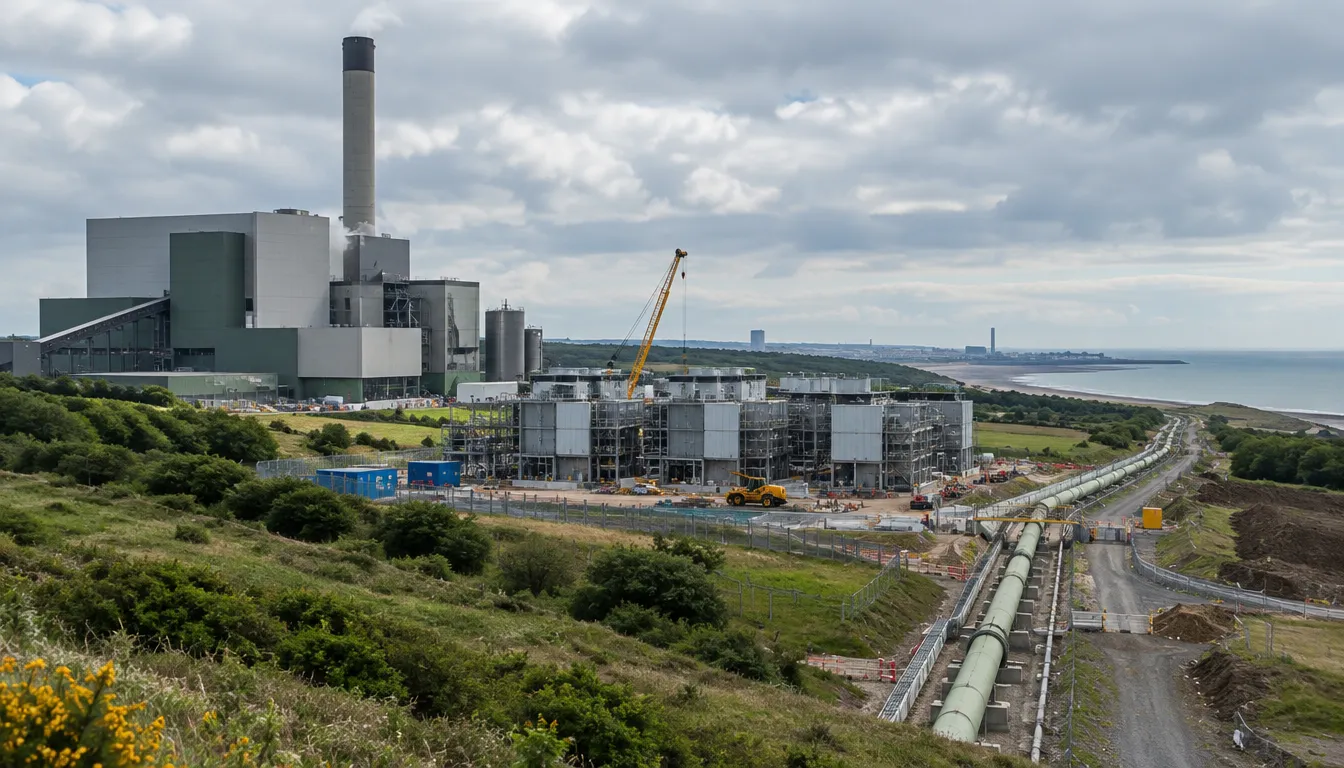
Veolia will design and supply two CO2 purification and dehydration units for the Protos carbon capture project in Cheshire, which targets commercial operation in mid-2029 and about 370,000 tons of CO2 captured a year.
Veolia will design and supply two CO2 purification and dehydration units for the Protos carbon capture project near Ellesmere Port in Cheshire, UK. Kanadevia Inova AG, the main engineering, procurement and construction contractor, awarded the contract. The contract value has not been disclosed.
The units will be retrofitted into Encyclis’ Protos Energy Recovery Facility. The plant processes up to 500,000 tons of non-recyclable municipal waste a year and delivers 49.9 MW of baseload electricity to the UK National Grid. The Protos carbon capture project is expected to capture about 370,000 tons of CO2 a year.
The two units are compact and modular. Veolia has built them to fit the site’s limited space. Their job is to remove impurities and moisture from the flue gas, so that the captured CO2 meets the purity thresholds for pipeline transport and subsea geological storage.
Purification sits between the capture step and the pipeline. CO2 taken from combustion gas carries water and other contaminants. Transport networks and storage sites set limits on both, so a plant cannot export CO2 until the gas meets them.
Captured CO2 from the Protos carbon capture project will enter the regional HyNet North West pipeline. It will be stored permanently in depleted offshore gas reservoirs beneath Liverpool Bay. The project targets commercial operation in mid-2029.
Once running, the facility is expected to be a net-negative emitter. The announcement does not set out how that figure is calculated, so it remains an expectation.
Veolia ties the award to its GreenUp strategic plan, which expands its carbon capture, utilisation and storage portfolio across Europe and North America. The contract is described as the company’s formal entry into the full-scale carbon capture market.
Anne Le Guennec, chief executive of Veolia’s water technology activities, said: “We are delivering on our promise to drive ecological transformation by enabling industries to transition toward net zero.”
The award arrives as UK policy on the technology shifts. The government has signalled reduced carbon capture support at the CCSA conference. Shared infrastructure such as HyNet North West therefore carries more weight for projects that need a route to storage.
Europe already has large capture plants in service. Yara opened Europe’s largest carbon capture plant at Sluiskil, which shows how fertiliser and other process emitters are moving first. Waste-to-energy plants such as Protos add a different type of emitter to the list.
The capture plant is a two-line facility built next to the waste-to-energy plant. It uses amine scrubbing supplied by Kanadevia Inova and will capture a mix of biogenic and fossil CO2 from burning non-recyclable waste. Kanadevia Inova received instructions to proceed in October 2025, after planning and environmental permits were granted. The programme runs three and a half years, with handover to Encyclis set for mid-2029.
Waste-to-energy plants are an unusual capture target because their feedstock is municipal waste, which varies from day to day. The Protos carbon capture project will therefore run purification equipment on a flue gas whose composition can change. Veolia describes its units as custom-built, though the announcement does not publish the purity level they will deliver.
The timing is tight. A mid-2029 start means the units must be built, shipped and commissioned alongside the capture plant itself, the HyNet connection and the offshore storage site. A delay in any one of these would hold up the whole chain.
The announcement gives no capital cost for the Protos carbon capture project and no price for Veolia’s units. Investors and local authorities will look for those figures, together with confirmation that the pipeline and storage sites will be ready by mid-2029.
