


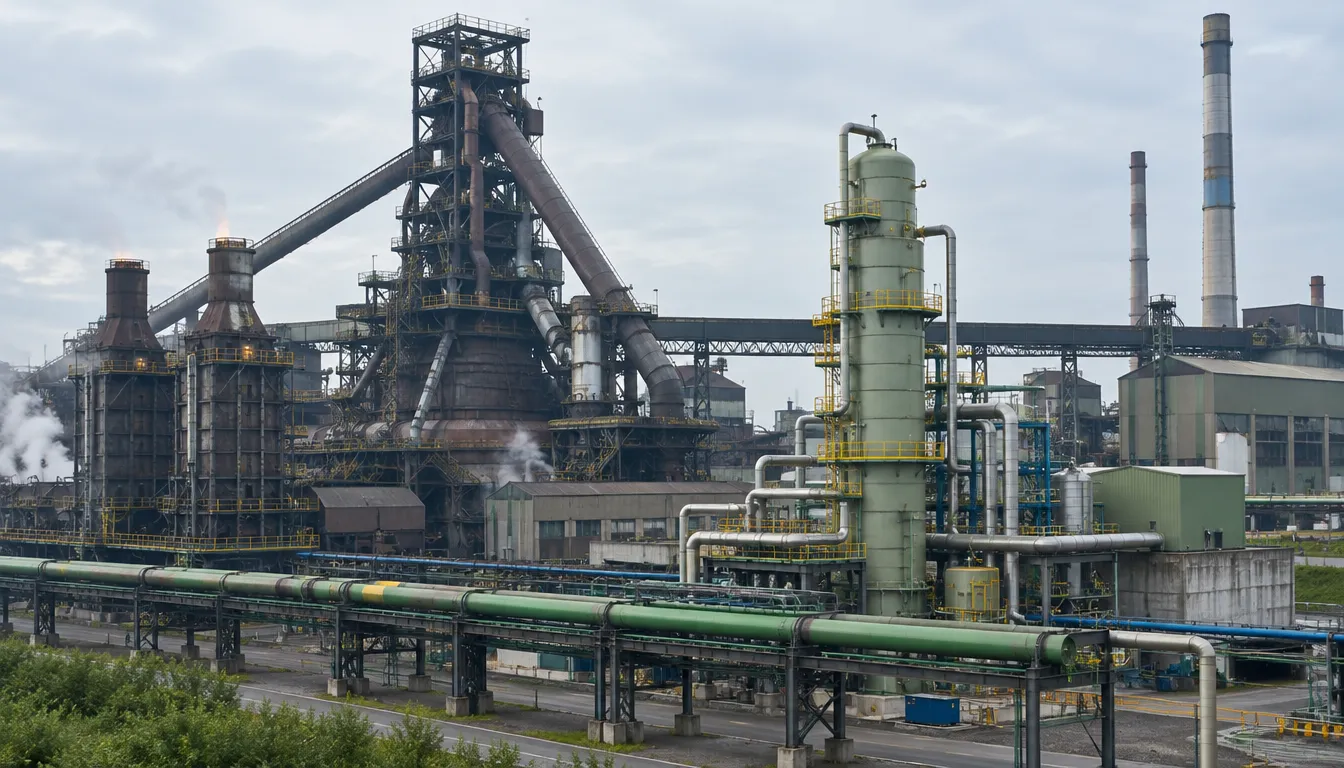
ArcelorMittal, Mitsubishi Heavy Industries, BHP and Mitsubishi Development have completed phase 1 of a blast furnace carbon capture trial in Gent, Belgium, capturing more than 90% of the CO2 in part of the off-gas.
ArcelorMittal and its partners have completed the first phase of a blast furnace carbon capture trial at the company’s integrated steelmaking site in Gent, Belgium. The pilot captured more than 90% of the CO2 in a proportion of the blast furnace off-gas. Testing ran for more than 4,500 hours.
Mitsubishi Heavy Industries (MHI) supplied its Advanced KM CDR Process and leads the carbon capture process engineering and technical evaluation. BHP and Mitsubishi Development Pty Ltd (MDP) provided funding. Both are key suppliers of steelmaking raw materials to ArcelorMittal’s European operations. ArcelorMittal facilitated the trial at Gent.
Phase 1 captured only CO2, and only from part of the off-gas stream. The announcement gives no gas volumes. Blast furnace off-gas contains dust, sulphur-containing compounds and other contaminants, which the trial had to handle. The remaining carbon monoxide could be used for on-site power and heat generation, with CO2 released on combustion.
The partners set out what full-scale use could deliver. Applying the technology to the pre-combustion blast furnace off-gas could cut the Gent site’s CO2 intensity by up to 24%. Applying it across multiple emission points could support near-zero emissions intensity. Both figures are projections.
Phase 2 widens the scope. The partners will capture CO2 from gases produced by the hot strip mill reheating furnace, which heats thick steel slabs for rolling into thin sheets. That furnace burns a blend of coke oven gas, blast furnace off-gas, basic oxygen furnace gas and natural gas. The flue gas is therefore more dynamic than in phase 1.
Results from phase 2 will inform updated engineering and deployment studies for future full-scale applications. The announcement gives no start date, duration or target hours for the second phase.
Dr Ben Ellis, vice president marketing sustainability at BHP, said it is “critical that we work to reduce emissions from the blast furnace process.” He noted that around 70% of global steel production comes from blast furnace steelmaking today. That share explains the interest in capture technology for existing assets.
Tadashi Mizuno, managing director and chief executive of MDP, said carbon capture on blast furnace gas “could provide a viable pathway for reducing emissions from the steel sector.” Tatsuto Nagayasu, senior vice president and head of CCUS at MHI, said the results “represent an important milestone for the application of MHI’s carbon capture technology in the steel industry.”
Frederik Van De Velde, chief executive of ArcelorMittal Belgium, described scaling up the technologies needed to decarbonise as “the vital next step.” ArcelorMittal operates in 60 countries and has primary steelmaking operations in 14.
Capture projects face scrutiny across European heavy industry. Heidelberg Materials recently paused its GeZero carbon capture project at its Geseke cement plant. Steelmakers weighing capture on existing furnaces will look for evidence that the process works on real, contaminated gas over thousands of hours.
Pilot results on real blast furnace gas carry weight because that gas is harder to treat than a clean test stream. The off-gas carries dust and sulphur compounds, and the trial ran for more than 4,500 hours of operation with those contaminants present. The announcement does not publish solvent losses, energy use or capture cost, so the economics remain open.
The 24% figure also shows the limits of the approach. Blast furnace carbon capture addresses one gas stream, so most of the site’s CO2 would remain unless capture is extended to other emission points. That is why phase 2 targets a second stream from the reheating furnace, and why the partners refer to multiple emission points.
The Gent trial supplies part of that evidence. The announcement does not give capture costs, a storage route for the captured CO2 or a timeline for full-scale deployment. Those three items will decide whether blast furnace carbon capture moves beyond the pilot stage after phase 2 reports.
