


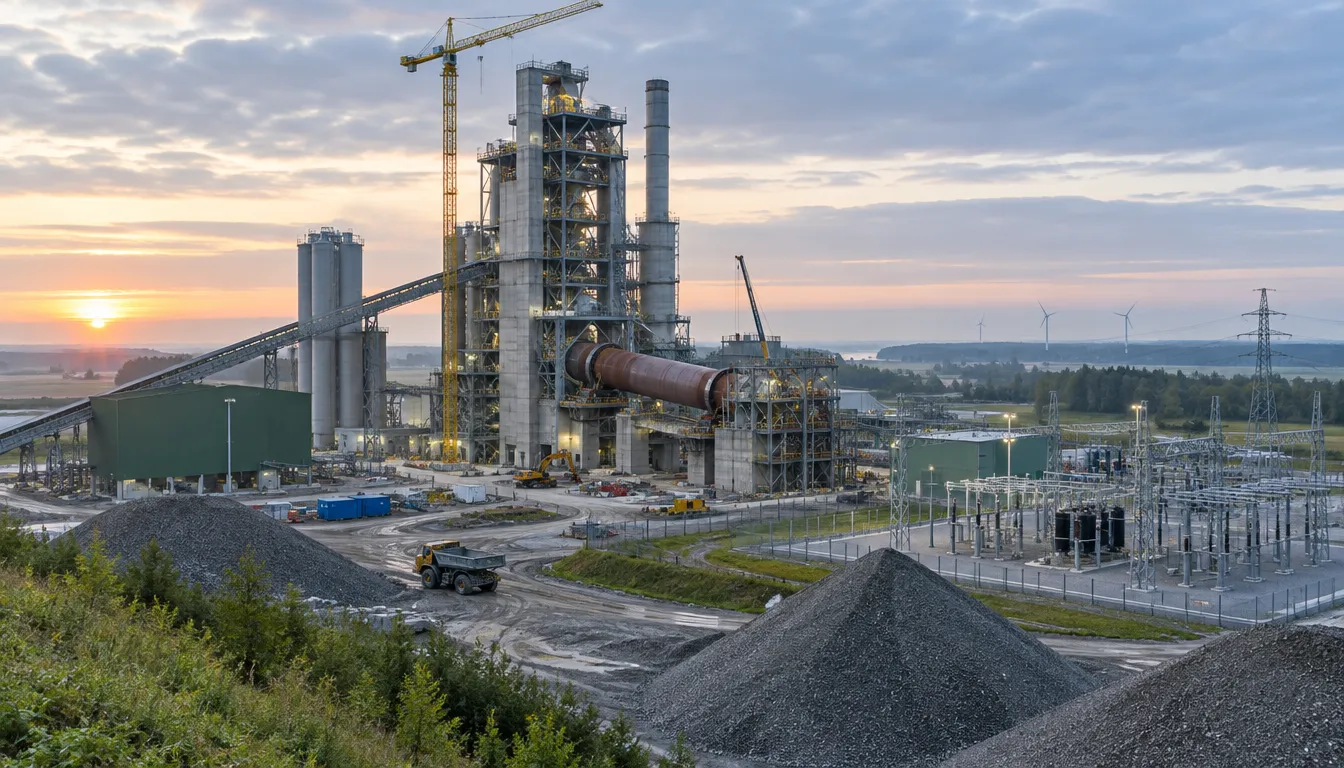
Swedish start-up Cemvision won up to €27.5 million from the EU Innovation Fund to build a low-carbon cement plant in Latvia, giving its steel slag process a first commercial site.
Sweden-based Cemvision has been selected for a grant of up to €27.5 million from the EU Innovation Fund. The money would fund a low-carbon cement plant in Latvia. The European Commission announced the selection on 19 October as part of a €3.4 billion package for 77 net-zero technology projects. The plant would make 0.5 million tonnes of cement a year. It would be the company’s first commercial-scale unit.
Cemvision makes cement from industrial by-products, including steel slag, using an electrified production method. The process is designed to cut greenhouse gas emissions below those of ordinary Portland cement. Cemvision has also announced a partnership with S:t Eriks on near-zero carbon concrete and an earlier agreement with Vattenfall on cement for energy infrastructure.
Chief executive Claes Kollberg welcomed the decision. “This grant brings us a decisive step closer to building our first commercial plant,” he said. The €27.5 million is a ceiling, so the final amount depends on the grant agreement.
What happens next
Cemvision now prepares that agreement with the European Climate, Infrastructure and Environment Executive Agency (CINEA). The agreement sets the budget, timetable, deliverables and legal responsibilities for the project. The Commission expects agreements to be ready in the first quarter of 2027. Cemvision expects to sign by March 2027.
Reports on the selection do not name a city for the Latvian site. They also give no start date for construction or production.
How the competition ran
The call drew 358 applications requesting €17.5 billion against a budget of €2.9 billion. Every one of the five topics was oversubscribed. Requests under the large-scale topic exceeded 7.5 times its initial €1.2 billion budget. The Commission launched the call in December 2025, and the fund detailed its €2.9 billion call at the start of this year.
The 77 winning projects sit in 23 countries of the European Economic Area. Independent experts scored each bid on five criteria: greenhouse gas avoidance potential, degree of innovation, project maturity, replicability and cost efficiency. No national quotas applied. Projects won on score, regardless of sector or location.
A further 84 projects passed evaluation without receiving money. Together with the 77 winners, they receive the STEP seal, which is meant to help them attract other public and private funding.
Where the money goes
Twelve large-scale projects take about €1.58 billion between them. They span five refineries, two CO2 transport and storage schemes, and projects in cement and lime, chemicals, iron and steel, and aviation. Medium-scale grants total about €458 million for 17 projects, and small-scale grants about €124 million for 20 projects. Clean-tech manufacturing receives almost €895 million for 12 projects, and 16 pilots receive about €394 million.
For the first time, the list includes a small modular reactor project and a direct air carbon capture and storage project. Six projects concern critical raw materials. The Commission estimates the 77 projects could avoid about 290 million tonnes of CO2 over their first decade. That is roughly one tonne a second for ten years, and it remains the Commission’s own projection rather than a measured result.
The fund draws its money from the auction of EU Emissions Trading System allowances. The Commission puts the total at about €40 billion for 2020 to 2030. After this round, the portfolio holds about 320 projects with almost €17 billion committed.
Implications for cement producers
Cement makers face a choice between capturing emissions at the kiln and changing what goes into the product. Cemvision’s route changes the inputs. A 0.5 million tonne low-carbon cement plant would test whether slag-based, electrified production holds up at commercial volumes and costs.
The next call opens in early December 2026. It includes a €1 billion clean-tech manufacturing topic to reduce supply chain risk under the RESourceEU Action Plan. For Cemvision, the nearer milestone is the first-quarter grant agreement, which turns a selection into a funded project.
