


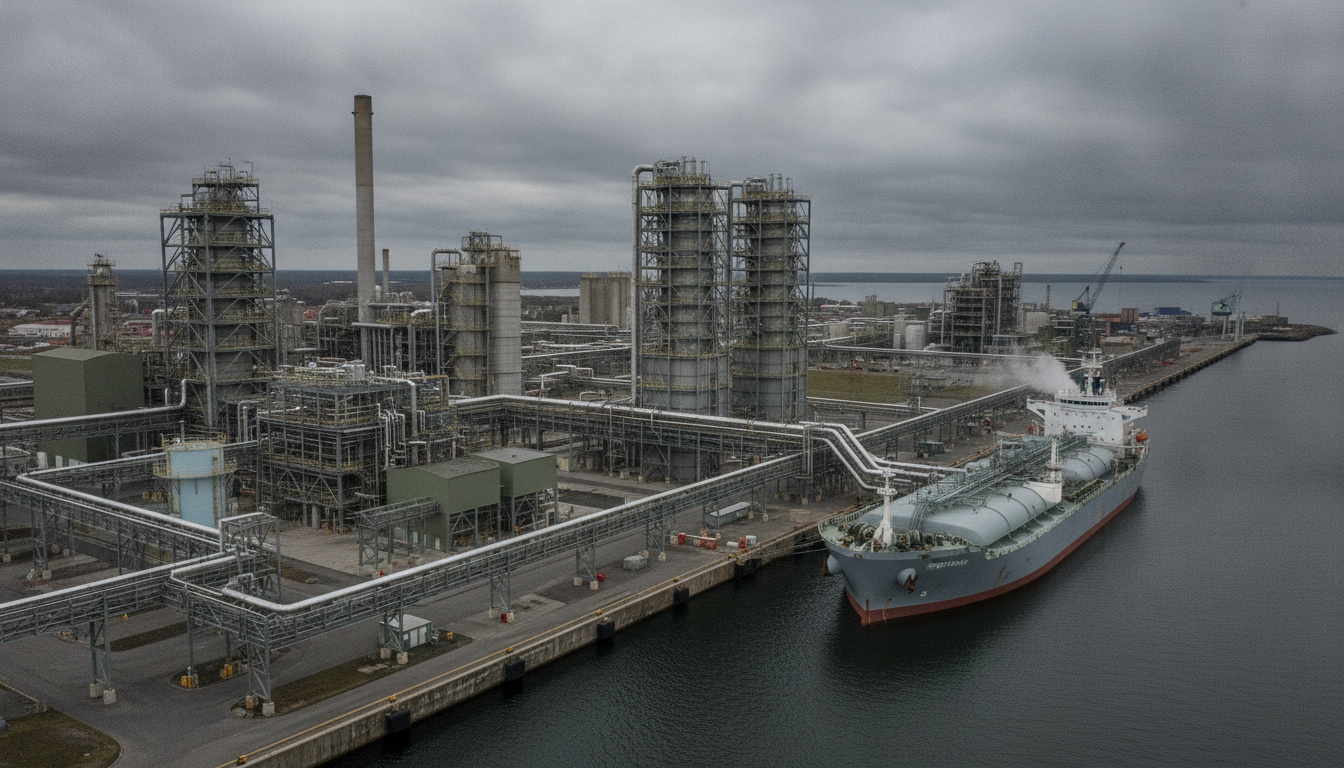
Yara International has opened an 800,000-tonne carbon capture facility at its Sluiskil ammonia plant in the Netherlands, launching a shipping link to permanent CO2 storage under Norway’s North Sea.
Yara International opened its new carbon capture facility at the Sluiskil ammonia and fertiliser complex in the Netherlands on 8 September 2026, according to gCaptain. The plant can capture and liquefy up to 800,000 tonnes of CO2 a year from ammonia production, making it one of the largest industrial carbon capture installations in Europe.
The captured CO2 will be loaded onto purpose-built vessels operated by Northern Lights, a joint venture between Equinor, Shell and TotalEnergies, and shipped to a receiving terminal at Øygarden on Norway’s west coast. From there it will travel through a roughly 100-kilometre pipeline before injection into the Aurora reservoir, some 2,600 metres beneath the North Sea seabed.
Yara expects the project to capture and permanently store around 12 million tonnes of CO2 over the next 15 years. Capturing the emissions will also let the company avoid European carbon costs on the volumes it sends for storage. “This is an important day for Yara and for European industry,” said Yara International president and chief executive Svein Tore Holsether. “The carbon capture facility in Sluiskil proves that large-scale industrial decarbonisation is possible today.”
The inauguration was attended by Norwegian prime minister Jonas Gahr Støre, Dutch prime minister Rob Jetten and European Commissioner for Climate, Net Zero and Clean Growth Wopke Hoekstra, alongside Holsether. “Europe needs practical climate solutions that deliver real emissions reductions while strengthening industrial competitiveness,” Hoekstra said. “The carbon capture and storage project at Sluiskil shows what is possible when innovation and cross-border cooperation come together.”
Northern Lights began commercial operations last year, receiving its first cargoes from Heidelberg Materials’ cement plant in Brevik, Norway. Its first phase can handle 1.5 million tonnes of CO2 a year and is fully booked. A second phase approved in 2025 is expected to lift capacity to at least 5 million tonnes annually, backed by €131 million from the European Union’s Connecting Europe Facility for Energy programme.
European policymakers increasingly see carbon capture and storage as a tool for cutting emissions in industries where electrification or renewable energy alone struggle to deliver, including fertiliser, cement and waste management. Yara operates what it describes as Europe’s largest ammonia and fertiliser plant at Sluiskil, and said the technology will help lower the carbon footprint of products including fertilisers, ammonia and, potentially, low-carbon fuels for shipping.
“This is a milestone we have been looking forward to,” said Tim Heijn, managing director of Northern Lights. “Together, we are demonstrating that capture and cross-border CO2 transport and storage is a viable solution for European industry.” Equinor, which provides technical services for Northern Lights, has said it is targeting between 30 million and 50 million tonnes a year of CO2 transport and storage capacity by 2035, across projects in Europe and the United States.
For industrial emitters facing rising EU carbon costs, the Sluiskil-to-Øygarden link offers a working template for connecting hard-to-abate sites without direct pipeline access to permanent storage. As Yara’s volumes join the network, seaborne CO2 transport is moving from demonstration project to a routine part of Europe’s industrial decarbonisation infrastructure.
