


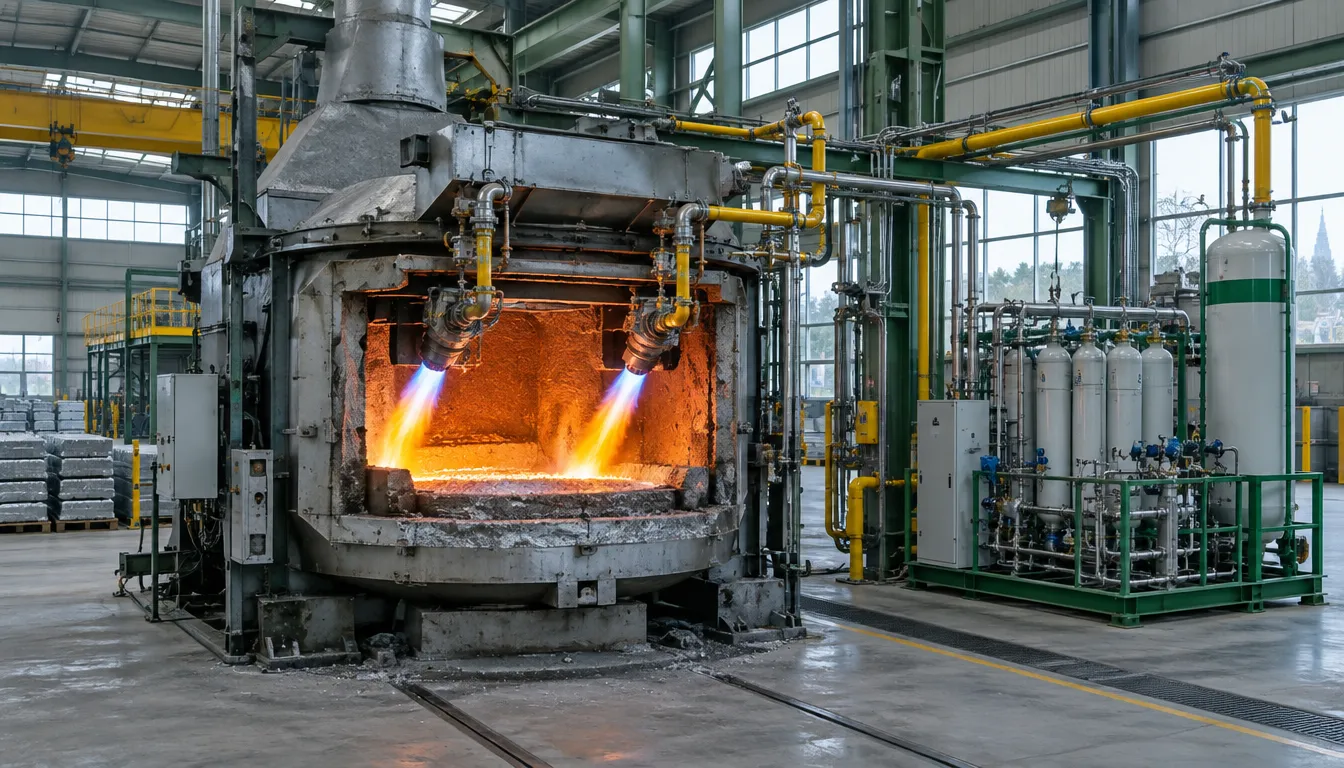
Höfer Metall Technik ran an existing melting furnace on hydrogen blends from 45% to about 100% in the HyAlu project, a real-plant test of hydrogen in aluminium production at Hettstedt, Germany.
Höfer Metall Technik (HMT) has used hydrogen successfully in production trials at its Hettstedt site in Germany. The tests ran an existing melting furnace on blends from 45% hydrogen to about 100% hydrogen in natural gas. The trial gives the sector a real-plant data point on hydrogen in aluminium production.
The trials form part of the HyAlu project, and the project’s own question is practical: can existing plants take hydrogen without a rebuild? It examines whether hydrogen can be added safely and efficiently to existing aluminium production. It also studies how the energy source affects the melting process, the quality and the properties of the metal.
Project partners and funding
Germany’s Federal Ministry for Economic Affairs and Climate Protection approved the three-year project for funding in 2024. HMT works with Jasper, the Gas and Heat Institute Essen (GWI), Bloom Engineering Company, the University of Magdeburg and Nippon Sanso Europe. Teams from HMT, GWI and Jasper took part in the trial.
The consortium combines a metal producer, equipment and engineering firms, a research institute and a university. HMT supplies the plant and the production setting, so the test took place in a working furnace and not in a laboratory.
How the furnace was converted
HMT modified its existing melting furnace to run on hydrogen. The furnace has two burners. The Association for Technical Inspection (TÜV) certified the hydrogen burner system before commissioning, and the commissioning went successfully.
The heating capacity is about 2.2 megawatts (MW). The fuels tested were hydrogen and natural gas enriched with hydrogen. Jasper built the piping, handled hydrogen transport, regulated the burners and modified the existing controls. That allowed the team to test different ratios of natural gas and hydrogen.
Results so far
The system ran with hydrogen concentrations from 45% to about 100% in natural gas. The burners behaved stably at all tested concentrations. Aluminium melting furnaces commonly run on natural gas, so a stable result across a wide hydrogen range is the first question for any operator weighing a fuel switch.
Formal results are still to come. Frank-Maik Elbracht, Head of Engineering at Jasper, said: “At this stage everything looks as good as predicted, we are still waiting for the reports.” He added that the modifications can be made within a short downtime. After that, the plant can switch or mix gases without further downtime because the equipment handles both gases.
What the reports need to show
The project’s own questions set the checklist for the reports. They cover safe and efficient addition of hydrogen, the effect on the melting process, the quality of the metal and the properties of an aluminium smelter. Until the evaluation is complete, the stable burner behaviour is the main confirmed result. Elbracht’s comment that everything “looks as good as predicted” is a progress statement from the engineering partner and not a published finding.
The short downtime he describes is also relevant to cost. A conversion that fits into a planned stop avoids lost production, and the ability to mix gases without further downtime lets a plant keep running on natural gas if hydrogen supply is short.
What comes next
HMT will evaluate what it learned and assess the potential of hydrogen for industrial-scale aluminium production. The reporting gives no date for that assessment. Operators of melting and holding furnaces will want to see the full reports, particularly on metal quality and on the cost of the hydrogen supply.
Other heavy industries are testing the same idea. Rohrdorfer completed a hydrogen combustion test at an Austrian cement kiln. Wider aluminium trends, including the effect of cheaper power, appear in coverage of how renewables are reshaping the global aluminium industry.
In short, the HMT trial shows that a conventional furnace can switch fuels with a short stop and certified equipment. The open questions are the reports, the economics and the availability of hydrogen at plant scale. Until those arrive, the result supports further hydrogen in aluminium production trials and not yet a rollout.
