


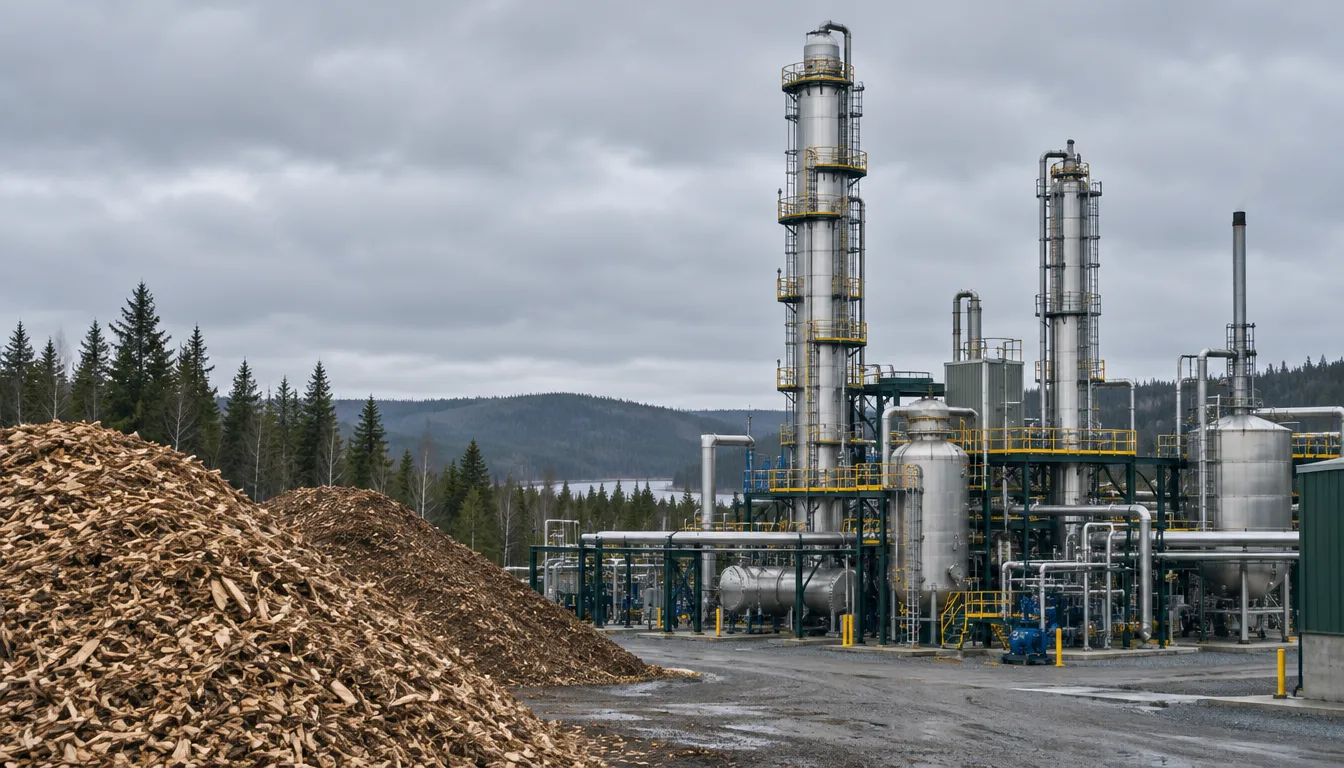
ARC Bio, a Canadian joint venture, ran biocrude from forest residues through a refinery-style unit and produced jet-range fuel, adding data for a sustainable aviation fuel pathway still under ASTM evaluation.
ARC Bio has shown that biocrude made from Canadian forest residues can run through a refinery-style fluid catalytic cracking (FCC) unit and yield a jet-range fraction. The company announced the results on 30 September from Port-Cartier, Quebec. Blended with fuel made from fats, oils and greases (HEFA), the jet-range fraction met the key ASTM D1655 fuel properties screened. The result is a pilot-scale milestone for sustainable aviation fuel (SAF) made from woody biomass.
What ARC Bio demonstrated
ARC Bio is a Canadian joint venture between an affiliate of Bioenergie AE Cote-Nord Canada (Bioenergie AECN) and Alder Renewables. Bioenergie AECN runs a fast pyrolysis plant at Port-Cartier that turns forest residues into bio-oil. Alder develops technology that upgrades bio-oil into a refinery-ready biocrude, which it calls Alder Renewable Crude.
In the test, forest-residue bio-oil became barrel-scale quantities of biocrude. A pilot FCC unit, built to simulate commercial refinery operation, then cracked the biocrude into a jet-range fuel fraction. Carbon-14 analysis confirmed the carbon in the product came from the wood feedstock.
ARC Bio says the Port-Cartier plant is North America’s largest fast pyrolysis bio-oil facility using wood residues. Its capacity is 40 million litres of bio-oil a year. Biocrude is easier to transport than bulky wood waste, so distributed forest operations could supply large central refineries.
Why refinery co-processing is important
Co-processing lets renewable biocrude share units that already make transport fuels. Refineries worldwide operate FCC units, which could limit the new infrastructure needed. Some pretreatment, upgrading and refinery adjustments may still be required.
Derek Vardon, chief executive of Alder Renewables, described the approach as “a scalable, capital-efficient route to bring forest-derived renewable carbon into aviation fuel markets.”
The market for sustainable aviation fuel is small. The International Air Transport Association (IATA) estimates global SAF output reached 1.9 million tonnes in 2025, or 0.6% of jet fuel use. At EU airports, SAF made up 1.1 million tonnes, or 2.8% of aviation fuel supplied in 2025, according to the European Union Aviation Safety Agency’s ReFuelEU Aviation report. Readers following sustainable aviation fuel production will recognise the gap between output and policy ambitions.
HEFA leads commercial SAF output today. Forest residues come from a different biomass pool, which widens the supply base beyond fats, oils and greases. Alcohol-to-jet is at early commercial stage. Fischer-Tropsch routes are approved with limited deployment. Pyrolysis biocrude co-processing remains under development and evaluation.
Approval and the forest sector
The pathway is still in ASTM qualification. The International Civil Aviation Organization (ICAO) lists Alder’s biomass pyrolysis route among processes under ASTM evaluation. As of July 2023, ICAO counted 11 approved SAF conversion processes and 11 under evaluation. The pilot results add data towards approval but do not make the pathway certified. Any blend limit under ASTM D1655 will depend on the approved pathway.
Serge Mercier, president of Bioenergie AECN, said “Canada has the biomass feedstock, the forest sector expertise” to support the effort. Bioenergie AECN is a joint venture of Arbec Forest Products and Groupe Remabec. ARC Bio says higher-value uses for residues can strengthen forest-sector economics. It also sees potential in residues from forest management and wildfire-risk reduction.
Boeing is investing CAD $10 million in Project Avance at Port-Cartier. Canada’s Clean Fuel Regulations create a credit market for gasoline and diesel suppliers. Low-carbon fuel producers, including SAF producers, can opt in as voluntary credit creators.
What happens next
ARC Bio will generate more refinery-relevant data to support larger trials. Its roadmap points to a first-of-a-kind Canadian commercial project that combines residue conversion, biocrude production and refinery integration. ARC Bio director Julien Lampron has said the next phase would involve a refinery co-located at a Bioenergie pyrolysis site. The company wants pyrolysis plants across Canada using forestry residues.
For airlines and fuel buyers, ASTM approval is the gate. Until the pathway qualifies, forest residue volumes stay outside certified sustainable aviation fuel supply.
