


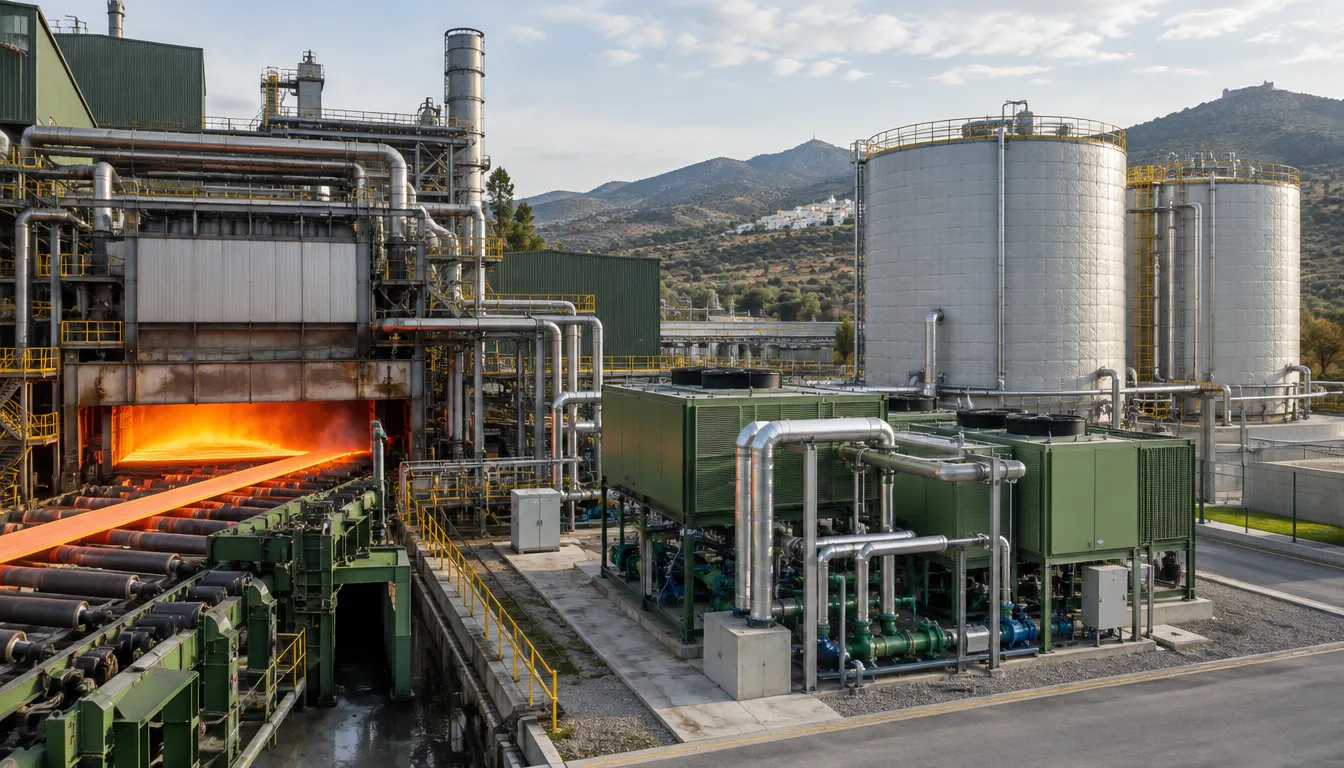
Acerinox and IGNIS will install a 12 MW industrial heat pump and 120 MWh of thermal storage at the Campo de Gibraltar stainless plant in Cádiz, cutting emissions by about 18,500 tonnes a year.
Spanish stainless steel producer Acerinox has partnered with energy company IGNIS on two decarbonisation projects at its Campo de Gibraltar plant in Cádiz, Spain. They will cut emissions from steam production and improve energy efficiency. Both are scheduled to become operational in December 2028.
The first project is a 12 MW thermal industrial heat pump. It recovers waste heat from the combustion gases of the hot rolling mill furnace. The plant then uses that heat to meet the thermal energy needs of the process.
The second project is a thermal energy storage system with a capacity of 120 MWh. It uses electrical resistance heaters to generate and store heat when electricity prices are lower. The store supplements the industrial heat pump and acts as a backup steam source during scheduled heat pump shutdowns.
Together, the installations are expected to cut carbon emissions by about 18,500 tonnes a year. That equals a reduction of about 10%. The company has not said which emissions baseline the percentage uses.
IGNIS will cover the initial investment of nearly €40 million. The projects have also secured €19.3 million in grants from Spain’s Institute for Energy Diversification and Saving (IDAE), which sits under the Ministry for the Ecological Transition and the Demographic Challenge. The European Union’s European Regional Development Fund co-finances the grants.
The structure shows how an industrial heat pump can reach a steelworks without the operator carrying the full capital cost. IGNIS pays upfront, and the public grants cover almost half of the sum. The announcement does not describe how Acerinox will repay IGNIS or what the commercial terms are.
Acerinox chief executive Bernardo Velázquez said the investments form part of the company’s efforts to improve energy efficiency and reduce emissions at its Campo de Gibraltar operations. The projects sit within Acerinox Europa’s long-term industrial improvement plans.
The pairing of a heat pump with storage addresses a practical issue. Steel plants need steam continuously, but electricity prices move through the day. Storing heat when power is cheap lets the plant draw on it later, and the store covers maintenance stops.
Large heat pumps are moving into heavy industry across Europe. Decarbonisation News has reported how large-scale heat pumps are shifting from pilot to mainstream deployment. Turboden also unveiled the world’s largest industrial steam heat pump at the Delfort paper mill.
The Cádiz project is smaller than those headline installations, but it applies the same logic to a stainless steel rolling operation. The 12 MW rating gives a sense of scale for process heat recovery at a single mill furnace.
The grants equal roughly 48% of the nearly €40 million figure. The sources do not say whether the grants reduce IGNIS’s outlay or sit on top of it, so the net private investment for the industrial heat pump and storage system remains unclear.
The capacity figures give a basis for comparison. A 120 MWh store paired with a 12 MW heat pump holds about ten hours of output at the heat pump’s full rating. The sources do not state the intended discharge rate, so that figure is an arithmetic illustration only.
For stainless producers, steam is a large and steady energy demand, and gas-fired boilers usually supply it. The announcement ties the 10% emissions cut to steam production. Replacing part of that demand with recovered heat and off-peak power therefore cuts gas use at the plant.
The announcement leaves some details open. It gives no electricity consumption figure for the heat pump, no total plant emissions and no date for construction to start. Those numbers will determine how far the 10% cut reflects the plant’s wider decarbonisation path.
