


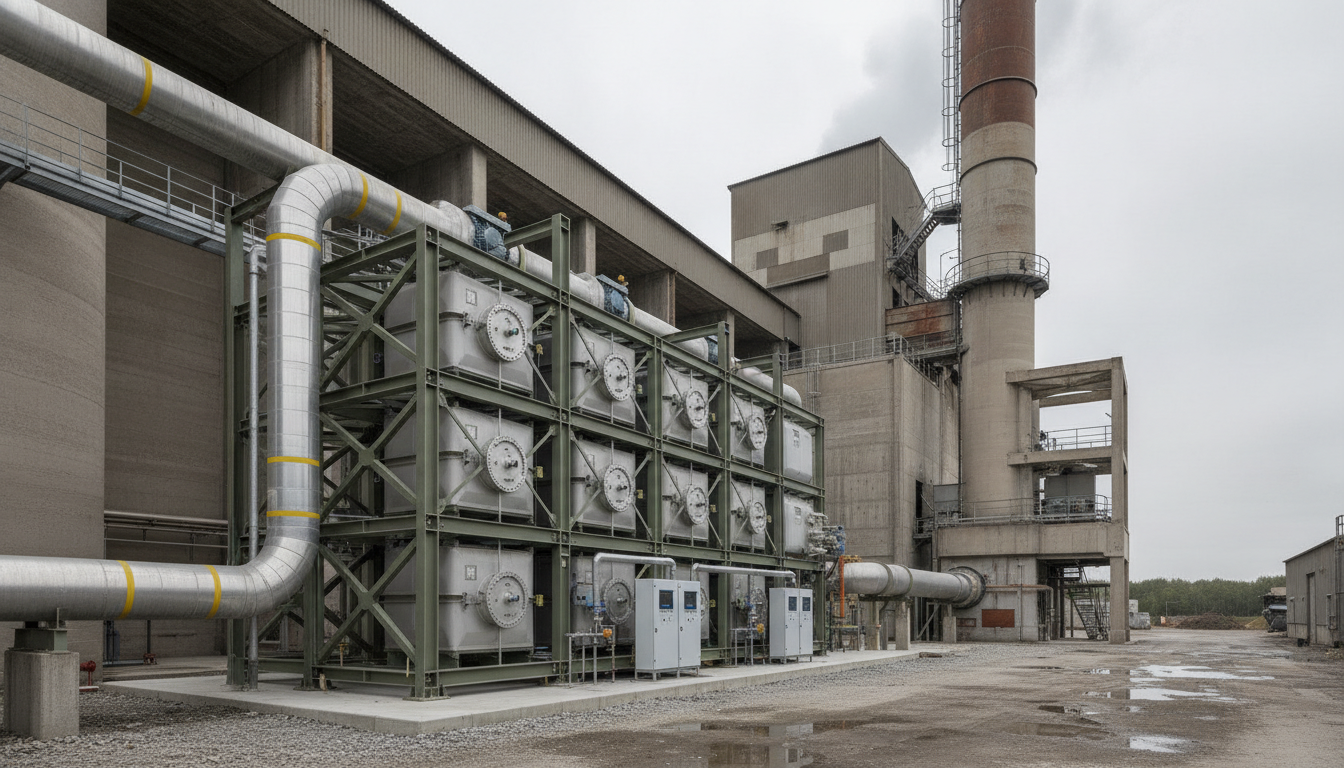
Holcim Germany has commissioned a membrane-based carbon capture demonstration at its Höver cement plant in Lower Saxony, capturing up to 10,000 tonnes a year and targeting 90% of site emissions after expansion.
Holcim Germany has commissioned a membrane-based carbon dioxide capture demonstration plant at its Höver cement works in Lower Saxony, according to International Cement Review. The facility was inaugurated on 21 August 2026 and is expected to capture up to 10,000 tonnes of carbon dioxide a year.
The installation scales up technology first piloted at Höver in 2022. Multilayer polymer membranes separate carbon dioxide from the plant’s flue gas. The Helmholtz Centre Hereon developed the system and Cool Planet Technologies commercialised it.
Holcim said that after the final expansion stage the technology is intended to capture around 90% of the plant’s roughly 500,000 tonnes of annual carbon dioxide emissions. The captured gas would be purified for potential industrial use.
Why membranes matter in cement
Most cement capture projects in Europe use amine scrubbing, a solvent process that needs heat to regenerate the solvent. Membranes separate gases on pressure difference instead, which gives the plant a different energy and cost profile.
Cement flue gas carries dust, sulphur oxides and moisture, all of which shorten the life of separation media. A demonstration on a live kiln stream tests durability in a way a laboratory gas mixture cannot. The 2022 pilot at the same site established that the materials work on real flue gas, and the new unit raises the volume passing through them.
The membrane system runs as an end-of-pipe process, so it can be retrofitted to existing cement plants without fundamental changes to production. Retrofit is the point. Cement lines run for decades, the kiln is the asset, and few operators will rebuild a working line to accommodate capture equipment.
Germany’s Federal Funding Programme for Industry and Climate Protection supports the project.
Scale is the open question
The 10,000 tonne figure is a demonstration volume. Reaching 90% of roughly 500,000 tonnes means capturing about 450,000 tonnes a year, a forty-five-fold increase on what the current unit handles. Holcim has not published a date for the final expansion stage.
Purification is the other variable. Carbon dioxide sold into industrial use has to meet purity specifications that vary by buyer, and membrane systems typically need multiple stages to reach high concentrations. Holcim said the captured gas would be purified for potential industrial use without naming an offtaker or a specification.
For cement operators, the value of Höver is a capture route that leaves the kiln alone. What the scale-up has to show is whether membranes can match solvents on cost per tonne across a full cement line.
