


Borouge International is expanding its Borouge AI and digitalisation programme across its global operations and expects the work to generate $100 million in value by 2027, with new partners including Microsoft and Emerson.
Borouge International has announced a wider Borouge AI and digitalisation programme at ADIPEC 2026 in Abu Dhabi. The petrochemicals group wants to become an AI-native company. The announcement came on 5 November. The programme covers production, innovation, supply chain, logistics and customer engagement.
The work builds on the integration of Borouge, Borealis and NOVA Chemicals. That widens the footprint of the Borouge AI programme to Europe, the Middle East and North America. Borouge International expects the initiatives to generate $100 million in value by 2027. The company calls this value generation. The reporting does not break the figure down. Dr Hasan Karam, chief operating officer of Borouge International and executive sponsor for AI and digitalisation, said: “these initiatives are expected to deliver $100 million in value generation by 2027.”
The company set out four goals for the Borouge AI effort. They are better operational availability and productivity, a stronger customer experience, better decision-making and high standards for health, safety and the environment.
At ADIPEC, Borouge International and its subsidiaries signed strategic partnerships with Microsoft, Emerson, Immensa and Cognite. The reporting names the four companies as partners for the AI and digitalisation work and gives no detail on the terms of each agreement.
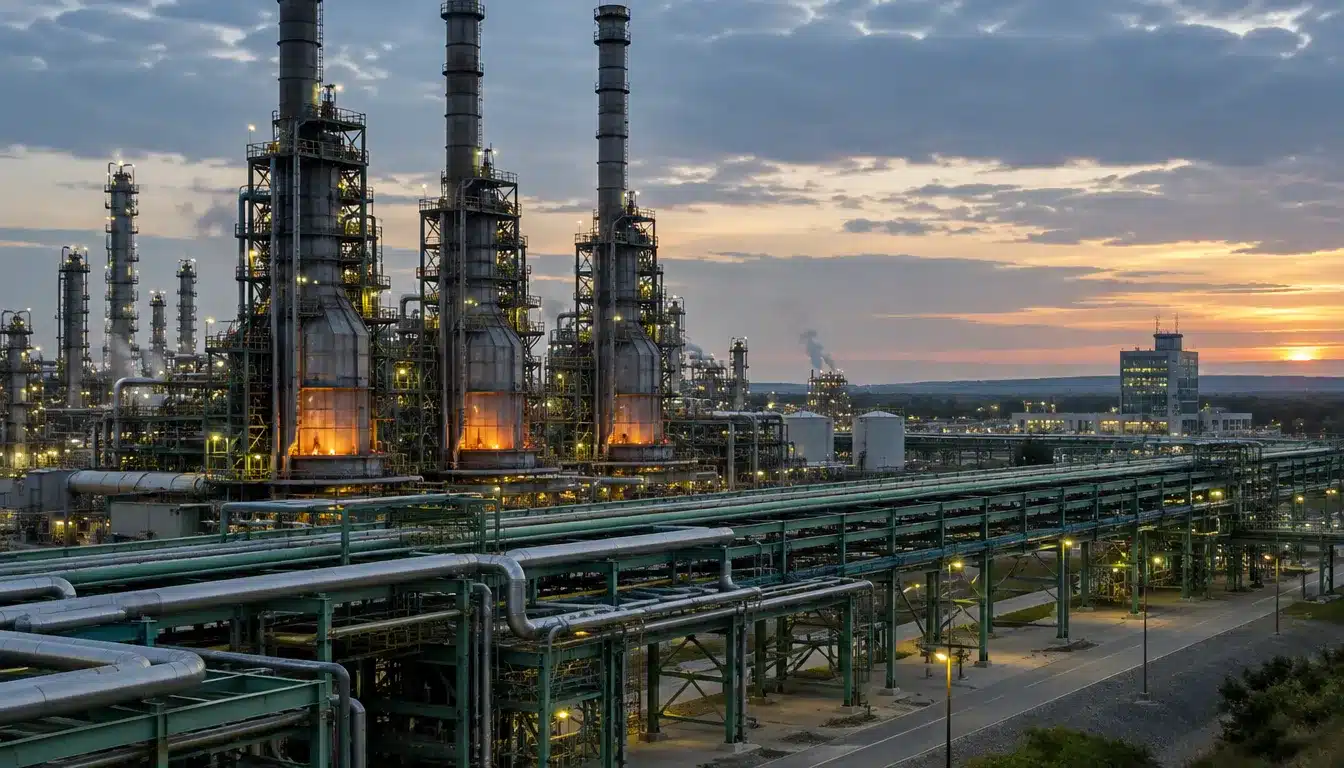
The largest live deployment is a real-time optimisation (RTO) system in the UAE. Borouge says it runs the world’s largest RTO system. Real-time optimisation adjusts operating settings continuously as plant conditions change, so the plant stays close to its best operating point. The system covers three large-scale ethane crackers and 20 furnaces. It analyses more than 2,500 parameters a minute. The company plans to roll the system out to facilities worldwide, including key sites in North America.
Other digital work includes machine learning for forecasting, digital twins for predictive maintenance and 3D printing for industrial additive manufacturing and supply chain efficiency. The company uses digital twins to cut asset downtime.
Earlier in 2026, Borouge completed a proof of concept for AI-powered autonomous operations at its Ruwais facility in the UAE, working with Honeywell. The company calls it an industry first. The trial ran in a live production environment. It showed potential for efficiency gains of up to 20%, a 20% reduction in downtime and operating cost reductions of up to 15%. Those figures describe potential. The reporting gives no results from a full-scale rollout. A 20% cut in downtime would raise output from the same assets without new capacity. A 15% cut in operating cost would lower unit costs for the Borouge AI sites that adopt it.
Borouge describes the Ruwais project as a step towards the petrochemical industry’s first AI-driven control room. That control room would run full-scale operations in real time. The proof of concept also targeted production performance, process safety and energy efficiency, according to the company. Energy efficiency is the clearest link to emissions in the reporting. A cracker or furnace that uses less energy per tonne of product burns less fuel, and that is the route by which the Borouge AI programme could cut emissions. The company gives no emissions figure.
Other operators are applying AI in different parts of the chemicals chain. The ENEOS AI catalyst discovery work in Japan targets materials research. Borouge AI tools target the operating side of the plant.
For petrochemical operators and investors, the Borouge announcement gives a benchmark for the scale of AI deployment at ethylene complexes. The $100 million target is a company expectation, and the reporting gives no baseline for it. The reporting does not say how many sites outside the UAE already run the system. The next test is whether the real-time optimisation system delivers its stated efficiency gains at North American sites, where plant design and energy prices differ from the UAE.
