


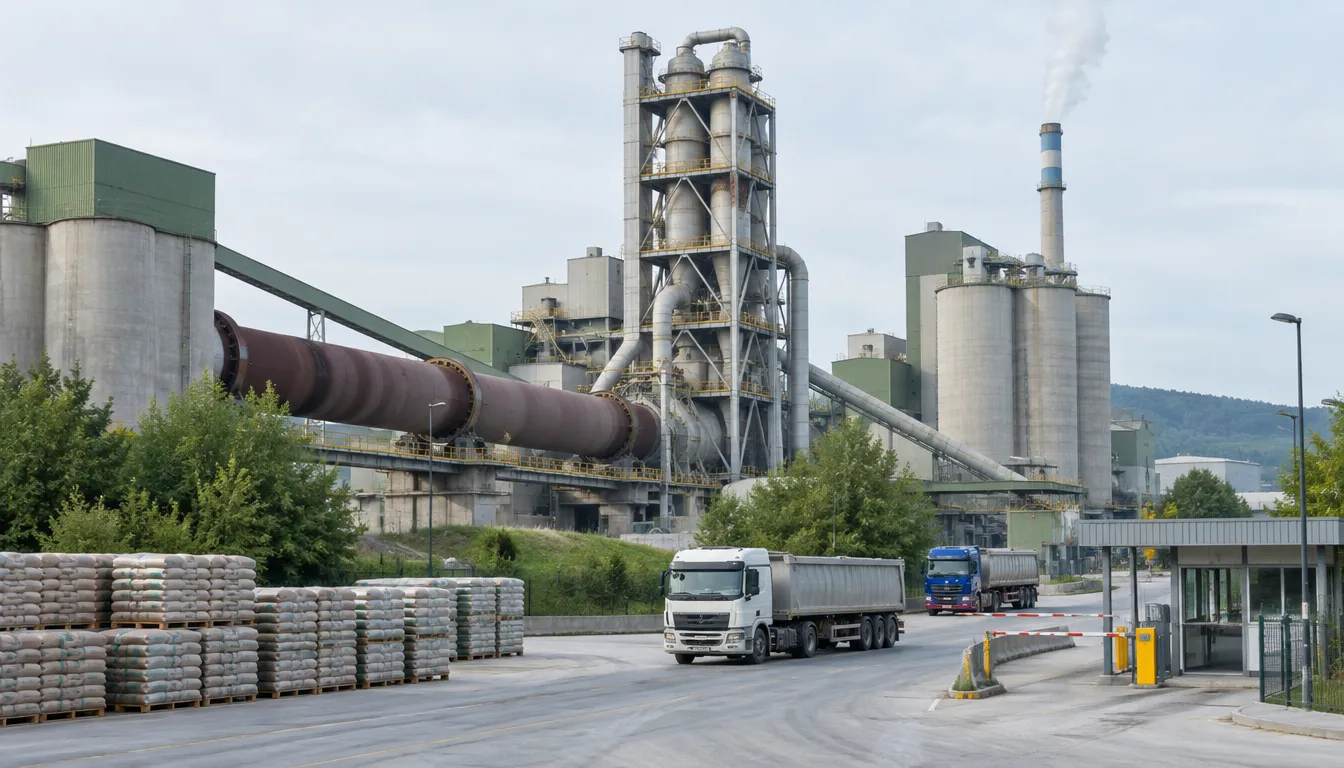
One year after launch, Cement Europe says the EU Cement Action Plan needs delivery on CBAM, electricity prices and CO2 infrastructure before its members can turn more than 120 innovation projects into plants.
Cement Europe says Europe’s industrial challenge calls for the conditions that let industry invest, and a weaker carbon price does not provide them. The trade body set out what is still missing at its annual event, one year after the launch of the EU Cement Action Plan.
The sector is investing. Cement Europe counts more than 120 innovation projects, including carbon capture projects, moving towards deployment. The business case for those projects depends on a watertight Carbon Border Adjustment Mechanism (CBAM), the right competitiveness conditions and what the association calls transition enablers.
Imports up, exports down
The association points to trade data to explain its urgency. Cement imports into the EU rose from 2.4 million tonnes (Mt) in 2016 to 14.2 Mt in 2025. Exports dropped by 63% over the same period. Those figures are the backdrop to the sector’s push for a border measure that works for both imports and exports.
EU plants buy allowances under the EU Emissions Trading System (EU ETS), so the shift in trade bears directly on their investment case. Cement Europe backs the EU ETS as a market-based instrument that gives long-term investment certainty. It argues against a weaker carbon price as the answer.
What is now in EU proposals
Several requests from the Cement Action Plan now appear in EU proposals under negotiation. The Commission’s review of the EU ETS covers market liquidity beyond 2040, reinvesting ETS revenues in industrial decarbonisation and including the capture and transport of CO2 for use. It also covers partially and gradually including municipal waste incinerators and clearer CO2 accounting.
The Industrial Accelerator Act and the Electrification Action Plan open the way to lead markets and more competitive energy, according to the association. A revision of CBAM is set to introduce a mechanism to address resource shuffling and circumvention. Each of these proposals is still under negotiation, so none of the Cement Action Plan requests is settled.
Six areas where delivery is outstanding
Cement Europe says the sector still needs delivery on six competitiveness drivers and transition enablers. The first is a watertight CBAM that covers imports and exports, is assessed against key performance indicators and closes loopholes. The second is competitive electricity prices, through lower taxes and levies and investment in the grid.
The third is a full level playing field with waste incinerators and equal access to alternative fuels for all combustible waste uses. The fourth is CO2 transport and storage infrastructure available where and when plants need it. The fifth is funding and de-risking at the scale the investments require.
The sixth is lead markets that reward low-carbon cement and concrete made in the EU. Cement Europe links this need to the Industrial Accelerator Act, which it says opens the way to lead markets. Taken together, the six items cover trade, energy, waste, infrastructure, finance and demand.
The industry position
Jon Morrish, President of Cement Europe, said the industry set out a year ago what it needs to decarbonise while staying in Europe, and that many of those requests are now on the table. “Our companies are investing,” he said. He called for “delivery, on CBAM, on energy prices and on CO₂ infrastructure” so that investments can proceed at scale.
For cement producers and their investors, the message is that the technology pipeline exists and the open questions sit in policy. Readers tracking the sector can compare this position with earlier coverage of membrane CO2 capture at a cement works and a Fastmarkets finding that a softer EU carbon price path would cut low-emissions steel output. Both show how closely plant investment follows carbon price signals.
The next test is the negotiation of the ETS review and the CBAM revision. If the Cement Action Plan requests survive in those texts, the sector will have most of what it asked for a year ago. If they do not, the Cement Action Plan risks stalling at the stage where projects need final investment decisions.
