


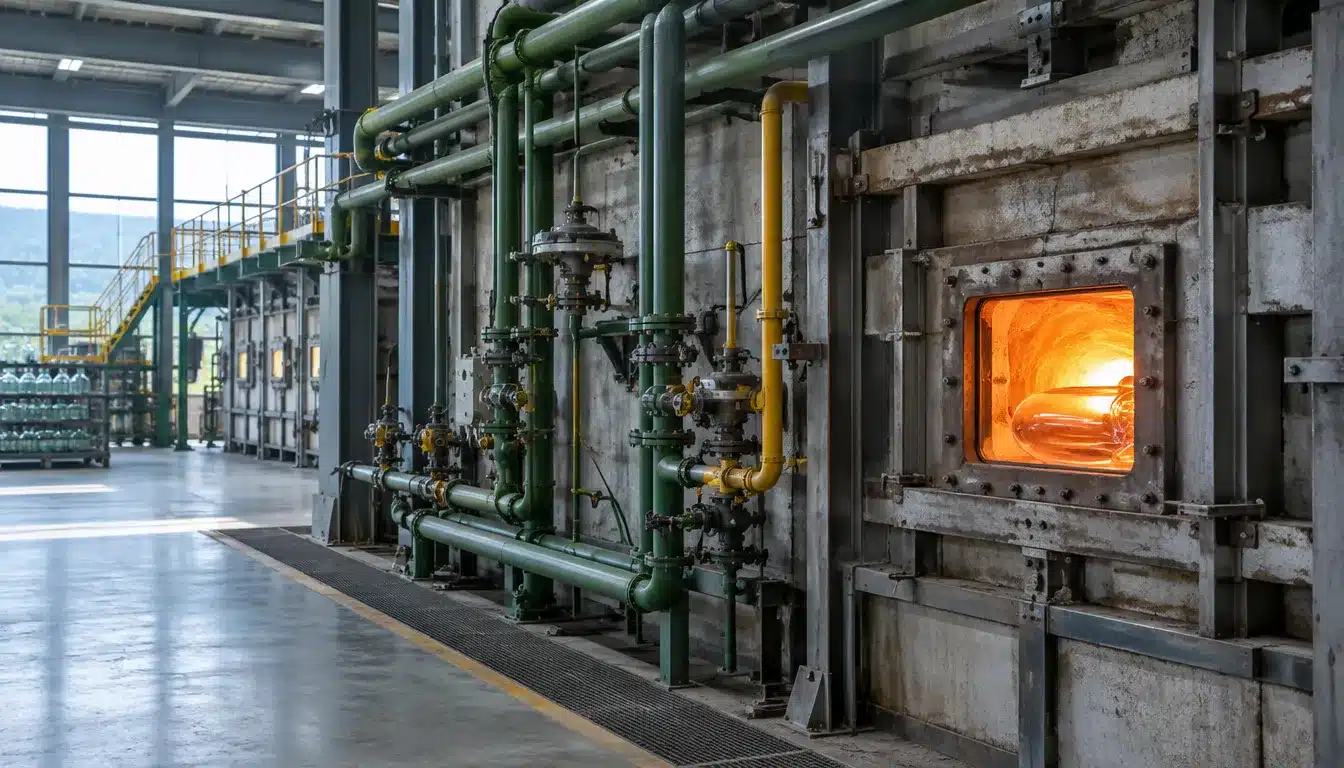
A new white paper sets out ten steps for glass industry hydrogen planning, helping furnace operators weigh electrification, hydrogen and hybrid routes before they commit to investments that will run into the 2040s.
A white paper from wvgw media gives glass manufacturers a ten-step approach to glass industry hydrogen decisions. The paper is titled “Hydrogen: what glass manufacturers can decide today”. It sets out how plant operators can prepare technology and infrastructure under uncertainty about hydrogen availability, prices and networks.
The publisher, wvgw media GmbH, is based in Bonn. The paper draws on the German Technical and Scientific Association for Gas and Water (DVGW) and its technical rules. It does not forecast hydrogen prices. It offers criteria for glass industry hydrogen investment choices that hold up whichever way supply develops. It also notes that decisions taken today carry technical consequences into the 2040s.
The editorial team compares three pathways. Electrification offers high decarbonisation potential with renewable power, and the checks are connected load, grid capacity and furnace suitability. A hydrogen route keeps the combustion process and the high process temperatures. Its checks cover hydrogen availability, burner and material changes, NOx emissions and cost. A hybrid route combines electricity with a gaseous fuel. Its checks are complexity, controllability, dual infrastructure and economic operation.
The ten steps run from site data to documentation. Operators first describe the site, including connected load, load profile, power and gas connection capacity, spare capacity and the timing of cold repairs. They then model at least three pathways on a comparable basis, using sensitivities in place of precise 2035 price forecasts. The paper treats cold repairs as decision points for burners, electrical capacity, pipe and cable routes and conversion interfaces.
Several steps deal with contracts and infrastructure. Operators should define hydrogen readiness in technical and contractual terms, including the intended hydrogen content, the components affected and evidence of suitability. They should share demand data with the network operator early, covering annual volume, capacity, load profile and timing. They should also reserve space, interfaces and routes during planned conversion work, so that a later switch costs less.
The paper asks glassmakers to model supply failure as its own scenario. Network expansion can run late, and maintenance can interrupt supply. Hybrid systems, alternative fuels, storage or redundant connections can cover those gaps. The paper adds that technical rules and standards should go into tenders across the whole chain, from the transfer station to measurement, control and safety systems.
The final steps cover governance. They apply to any glass industry hydrogen decision, because prices and infrastructure will shift between the planning stage and the final investment. Operators should set decision points that link market and infrastructure monitoring to fixed milestones. They should also document each investment decision, recording the energy and CO2 price ranges assumed, the network assumptions, the minimum technical requirements and the exit points. A timing table advises updating pathways three to five years before a cold repair.
Germany’s planned hydrogen pipeline grid forms the backdrop for glass industry hydrogen plans. The paper cites a hydrogen core network of about 9,000 km, to be built in stages by 2032. Roughly 60% of it will use converted natural gas pipelines and about 40% will be new-build.
The paper also covers regulation, safety and emissions. DVGW is adding hydrogen-specific requirements to its technical rules. They let suitability rest on standardised requirements rather than case-by-case assumptions, with most relevance at the interface between the public network and the plant’s gas system. Established safety principles need adapting for hydrogen, including leak detection, ventilation, pressure regulation, explosion protection, safe shutdown, and inspection and maintenance. NOx formation can rise with higher flame temperatures unless operators adapt combustion control. The paper gives no numerical limits.
Other operators are already testing alternatives. Cement producers have run a hydrogen combustion test at a kiln. In glass, France leads Europe on hybrid furnaces in the glass sector. For furnace owners, the white paper gives a checklist and no verdict on the best route. Glass industry hydrogen planning, in the paper’s framing, will depend on the next cold repair date, the local grid and the gas network operator’s timetable.
