


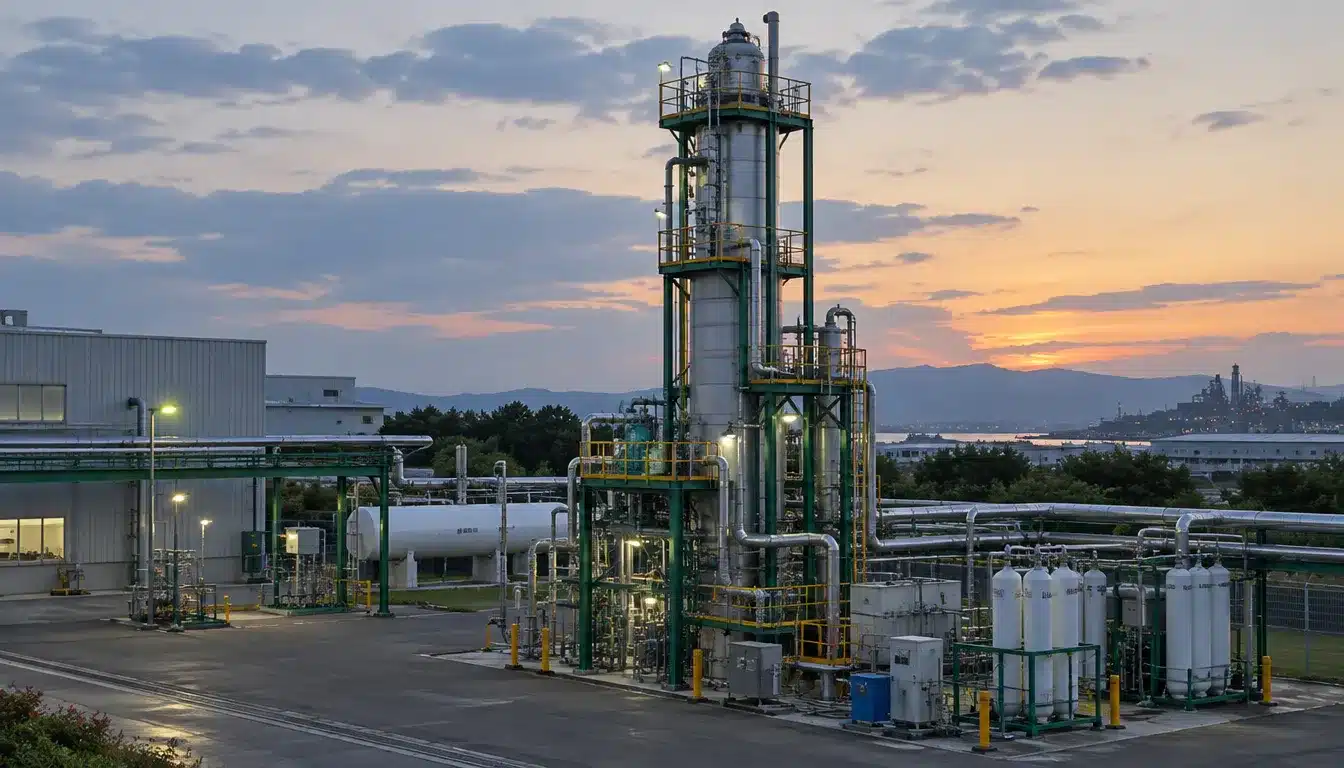
Nippon Steel has run a pilot shaft furnace on 100% hydrogen and lower-grade ore, producing more than 1,000 tonnes of hydrogen DRI and clearing 300 hours of continuous operation at its Hasaki centre.
Nippon Steel has reported a successful test of hydrogen DRI production from lower-grade iron ore. The pilot-scale shaft furnace at the Hasaki Research & Development Center made more than 1,000 tonnes of direct reduced iron (DRI) in total. It used 100% hydrogen as the reducing agent. The company announced the result on 4 November.
Direct reduced iron is made by stripping oxygen from iron ore in a shaft furnace without melting it. Steelmakers then melt the product in an electric arc furnace. Most DRI plants use natural gas as the reducing gas, so the step emits CO2. Nippon Steel says about 100 million tonnes of DRI are made each year worldwide in natural gas-fired furnaces. Hydrogen would remove that fossil fuel input from the reduction step.
The Hasaki furnace stands about 60 metres tall and has a capacity of 1 tonne an hour. It began operating in March 2026. The test ran for more than 300 hours of continuous operation. The 1,000 tonnes is a cumulative total, and the release gives no start or end dates for the test. That makes the hydrogen DRI result a pilot-scale data point rather than a plant-scale one.
The ore is the second point of interest. The test used blast furnace grade pellets. These carry less iron than the direct reduction grade pellets that conventional DRI plants use. Nippon Steel notes that the supply of high-grade ore is limited. The company wants to use the more abundant lower grades. A process that tolerates them would give DRI operators a wider choice of feedstock.
Two technical problems came up during the work. Reduction with hydrogen alone absorbs heat, so the temperature inside the furnace tends to fall. Lower-grade ore also breaks down into powder during reduction. That powder hurts gas permeability and makes the reaction harder to control. Nippon Steel said it addressed the heat loss with thermal compensation technology designed for the reaction. It tackled the powdering with operating techniques that suppress it.
The work forms part of the Nippon Steel Carbon Neutral Vision 2050. That plan has three core technologies. They are high-grade steel production in large electric arc furnaces. They also include hydrogen reduction in blast furnaces and DRI production using hydrogen. Japan’s NEDO Green Innovation Fund selected the project in January 2022 and expanded in November 2023. Nippon Steel works on it with JFE Steel Corporation and the Japan Research and Development Center for Metals.
Hydrogen DRI tests will continue at the pilot furnace. The aim is to establish the technology and settle operating conditions. From fiscal 2027, Nippon Steel will advance development, including scale-up technologies. The company has set around 2040 as the point to establish implementation technology. That timetable leaves many years of testing between the Hasaki result and a commercial hydrogen DRI plant.
The result adds to other recent data on iron and steel routes. A separate study found that the company’s Yawata electric arc furnace would emit about 278 kg of CO2 a tonne. Another study of green steel in India found costs of $571 to $606 a tonne against $536 for blast furnaces.
For steelmakers and ore suppliers, the result shows a pilot furnace running on 100% hydrogen and lower-grade pellets for more than 300 hours. Commercial-scale performance, hydrogen cost and hydrogen supply remain open questions at this stage. The release contains no cost figure for the process. Buyers of green iron therefore have no price signal from this announcement yet. Operators planning hydrogen DRI capacity will watch the fiscal 2027 scale-up work for the first indication of cost. Hydrogen supply will also shape the timetable. A commercial-size plant needs a steady flow of low-carbon hydrogen, and that infrastructure is still being built in most steelmaking regions.
