


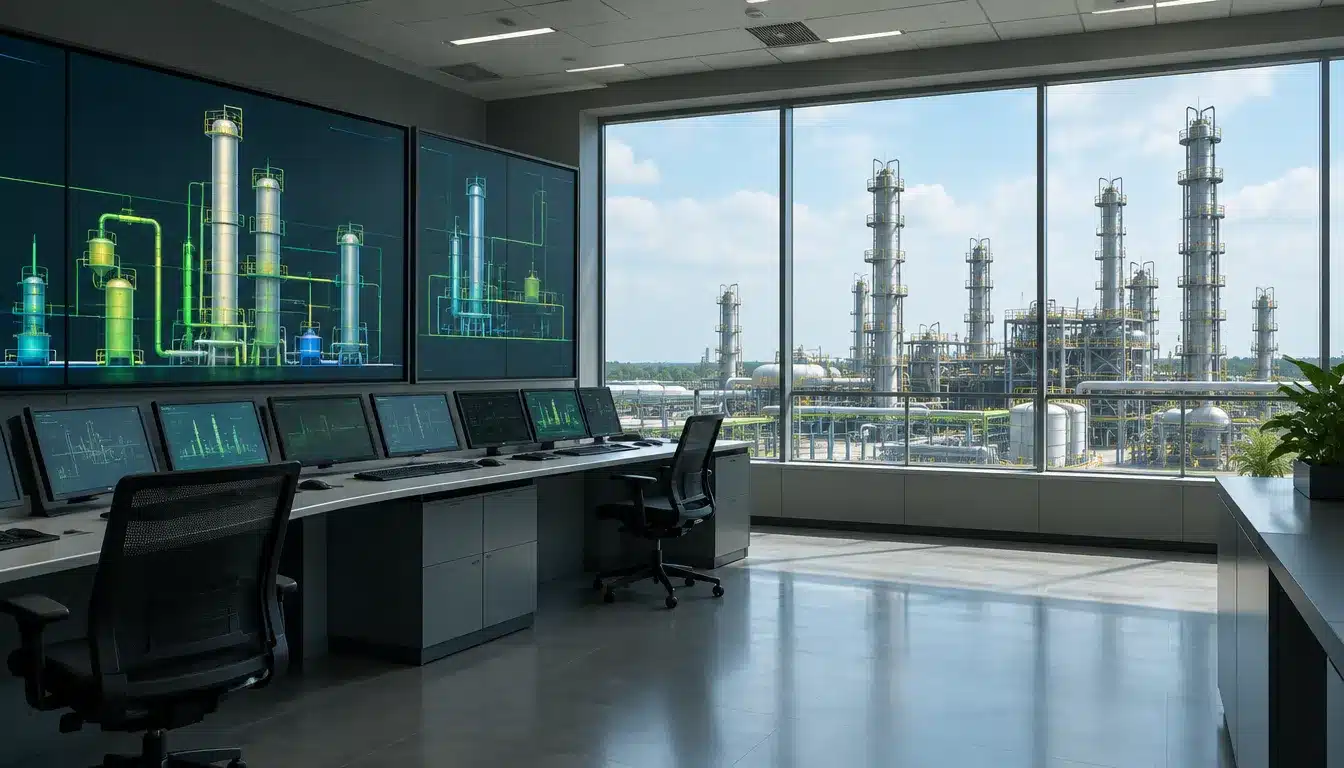
Evonik Oxeno has put AI process models into live plant operations at Marl and Antwerp to improve energy efficiency and speed decisions when feedstock changes.
Evonik Oxeno has introduced AI process models into live plant operations for the first time. The models, developed in the COMPAS project, aim to improve energy efficiency, lower CO2 emissions and speed up decisions when feedstock streams change. Evonik Industries announced the step for its Oxeno business, which operates in Marl, Germany.
Why did the team build the models?
Some process conditions inside a chemical plant cannot be observed directly. Conventional simulations of those conditions are complex and slow, which limits their use when operators need an answer during production. The COMPAS team responded by building gray-box models, which combine process knowledge with data, on more than one million pre-calculated plant simulations.
Once trained on that library, the AI process models can recommend plant control actions within seconds. That speed is the practical gain, because a recommendation that arrives while feedstock composition is shifting can still be acted on. Evonik says the approach helps keep energy use down as conditions change.
What do the results show so far?
The technology is already used in operations in Marl and Antwerp. According to the announcement, model results closely match operating data. Evonik says this minimises the energy needed for production and improves the carbon footprint of the plants concerned.
The announcement gives no percentage savings, no energy figures and no emissions numbers. Readers should treat the efficiency claim as a stated direction supported by agreement between model output and plant data.
Dr Niklas Paul, head of engineering at Evonik Oxeno, said: “We combine our extensive knowledge of chemical processes with the capabilities of artificial intelligence.” He described the aim as letting complex simulations support plant control under changing conditions.
What comes next for the AI process models?
More applications are under way, including the automatic transfer of model results to the plant control system. Today the models recommend actions. Automatic transfer would pass their outputs straight into the control layer, which shortens the path from calculation to operation.
Prof Dr Robert Franke, head of Simulation & Kinetics at Evonik Oxeno, put the longer-term goal this way: “Based on this technology, we are working step by step toward a self-optimizing C4 Verbund.” The C4 Verbund is the integrated network of C4 chemicals production that Oxeno runs, so a self-optimising version would adjust operating decisions across linked units.
The team has published the methodology and findings in Chemie Ingenieur Technik and Chemical Engineering & Technology. Journal publication gives other process engineers a way to examine how the models were built and validated. Evonik also says the approach could apply to other chemical and petrochemical processes, and the team is expanding its scope and seeking patent protection.
How does this sit alongside other efficiency work?
Software that tunes existing plant is one route to lower energy demand in heavy industry. Hardware changes are another, such as the industrial heat pump and heat storage planned at Acerinox’s Cádiz stainless steel plant. The two routes address different parts of the same problem, since a plant that runs closer to its optimum needs less energy whatever technology supplies it.
For chemical producers, the open questions concern scale and evidence. Evonik has not said how many units run the models today, how often operators follow the recommendations or what the energy saving amounts to in tonnes of CO2. Those numbers would show how far AI process models can move the emissions of a continuous process, and the company’s planned expansion should produce them.
For now, the announcement establishes that AI process models have moved from development into routine use at two sites, with the control-system link as the next milestone. The next evidence will be energy and emissions data from Marl and Antwerp, if Evonik publishes it, and any results from the automatic link.
