


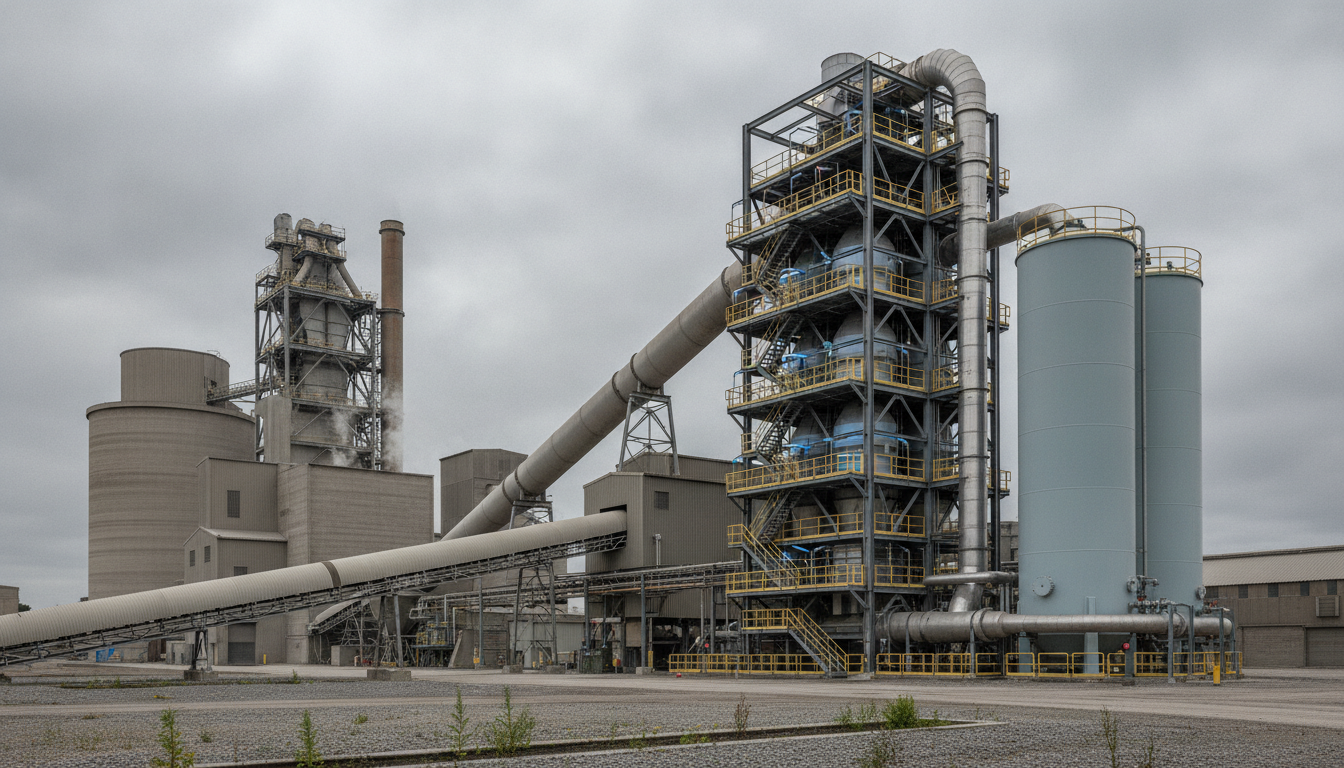
Carbon capture is starting to cut emissions from cement, an industry behind up to 8% of global CO2, with plants at Brevik in Norway and Padeswood in Wales leading the way.
Carbon capture is beginning to cut emissions from cement without changing the concrete that engineers rely on, New Civil Engineer reported on 30 July 2026. Cement, the binder in concrete, generates as much as 8% of global CO2 emissions, which makes it one of the hardest materials to decarbonise.
Most cement emissions come from the chemistry of making clinker rather than from fuel alone, so switching energy source cannot solve the problem on its own. Capturing CO2 at the plant leaves the finished cement unchanged. That avoids the testing and specification hurdles that new low-carbon mixes create for construction programmes.
Heidelberg Materials opened the world’s first carbon capture facility at a cement works at Brevik in Norway in June 2025. The plant captures CO2 from cement production for permanent storage, and its output is sold as evoZero, a cement the company markets as made with captured carbon. It gives specifiers a lower-carbon product without reformulating concrete.
In the UK, the Padeswood CCS project in Wales is designed to capture around 95% of the plant’s CO2 emissions, about 800,000 tonnes a year. Projects like these show carbon capture moving from pilots to full-scale operation at cement works, the point at which the technology starts to matter for the sector’s emissions.
Carbon capture and storage is a growing sector worldwide, and cement is one of its clearest use cases because the process emissions cannot be removed by other means. The captured CO2 has to be transported and stored permanently, which ties cement decarbonisation to the wider build-out of CO2 pipelines, shipping and storage sites.
For construction, the appeal is practical: lower-carbon cement that behaves like the product engineers already use. Wider adoption depends on capture costs, access to CO2 storage and whether buyers will pay a premium for cement made with captured carbon.

1 Comment
Pingback: Near-zero carbon concrete: Cemvision and S:t Eriks team up