


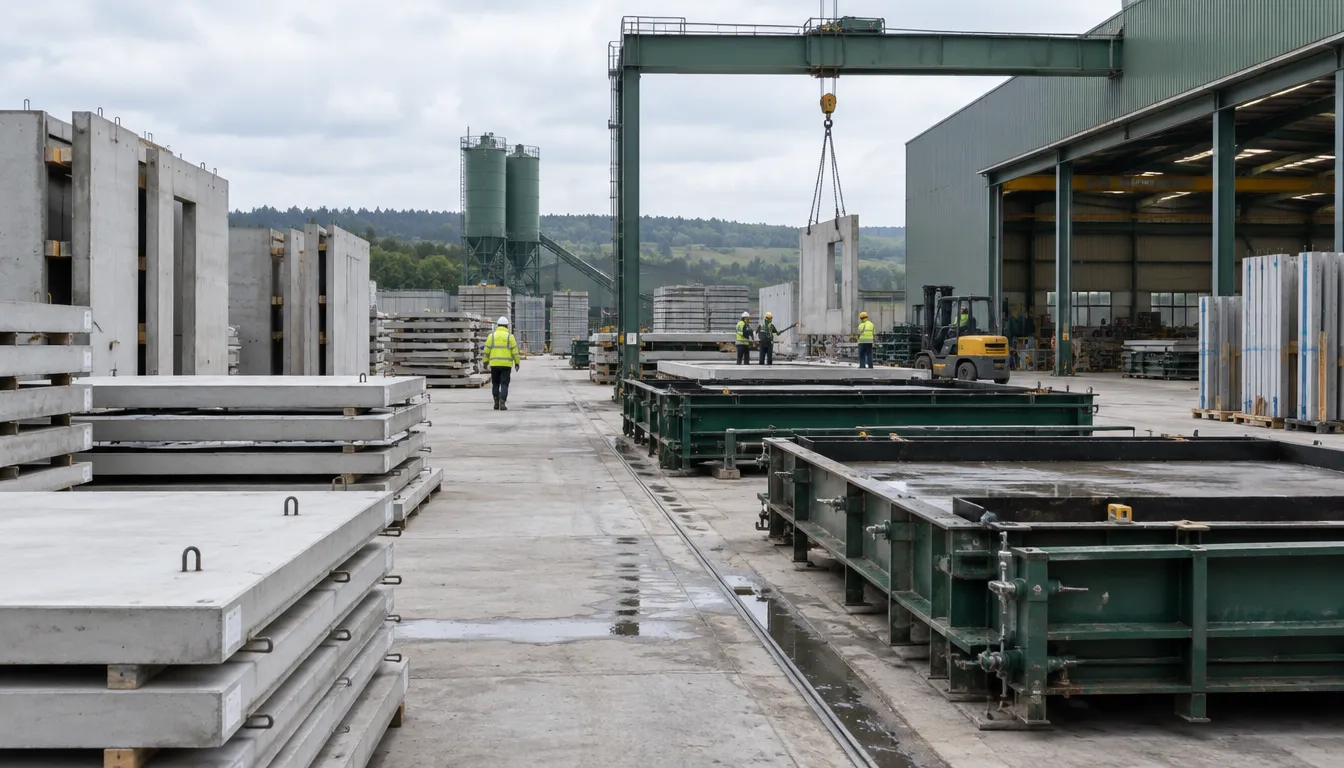
Swedish cement technology company Cemvision and precast concrete manufacturer S:t Eriks have signed a partnership to bring near-zero carbon concrete to the Nordic and Baltic construction markets by 2028.
Swedish cement technology firm Cemvision and precast concrete manufacturer S:t Eriks have signed a joint sales agreement to develop and commercialise near-zero carbon concrete products for the construction and infrastructure sector across the Nordics and the Baltics.
Cemvision develops what it calls Re-ment Massive, an ultra-low carbon cement designed to replace conventional Portland cement in structural applications without requiring contractors to change how concrete is placed or cured on site. Under the agreement, S:t Eriks will incorporate the cement into jointly developed near-zero carbon concrete products, which it will manufacture and distribute to contractors, infrastructure developers and landscape architects across the two regions from its existing precast network.
“At S:t Eriks, we believe that sustainable construction shouldn’t mean compromising on quality or performance. Our partnership with Cemvision lets us offer customers something genuinely new: low-carbon concrete products that meet the standards that the market demands, allowing them to become leaders in the green transition,” said Therese Kvarnström, quality and sustainability manager at S:t Eriks.
Cement production is among the most emissions-intensive industrial processes, and conventional Portland cement remains the default binder for most concrete despite years of low-carbon alternatives reaching pilot and early commercial stages without displacing it at scale. Pairing a low-carbon cement developer with an established precast manufacturer is designed to shorten the path from laboratory formulation to products that contractors can specify at scale, rather than leaving new cement chemistries stuck at demonstration volumes for years while buyers wait for a track record.
“This partnership is a significant step in our mission to decarbonise the built environment. Working with S:t Eriks, one of the most respected names in Nordic concrete products, gives us the commercial reach to turn our technology into real-world impact,” said Oscar Hallén, chief executive of Cemvision.
The companies will collaborate on product development, testing and verification, joint marketing and customer outreach ahead of commercial launch. Commercial deliveries are expected to begin in 2028, once Cemvision completes its first industrial-scale production facility, a timeline that gives both companies several years to validate performance across different concrete applications, from precast panels to structural elements, before wide distribution begins across the two regions.
The 2028 timeline also reflects a broader pattern in low-carbon cement: most new chemistries need years of third-party testing and building-code approval before structural engineers will specify them on anything beyond demonstration projects. A precast partner with an established quality system can help compress that approval process by generating consistent, auditable performance data from day one, rather than each project starting its own approval process from zero.
Precast production also gives Cemvision a controlled environment in which to prove out Re-ment Massive before it reaches site-poured concrete, where mixing, curing and weather conditions are harder to standardise. Factory conditions allow both companies to gather consistent strength and durability data across repeated production runs, the kind of evidence structural engineers typically require before specifying a new binder on anything beyond a pilot project.
The Nordic and Baltic construction markets have been early adopters of low-carbon procurement rules for public buildings and infrastructure, which gives near-zero carbon concrete a readier customer base than in markets where carbon requirements remain voluntary. That regulatory backdrop is part of why Cemvision and S:t Eriks chose the region for a first commercial push rather than a smaller pilot market.
The Cemvision deal sits alongside other routes to lower-carbon cement, including carbon capture retrofits that cut emissions without changing the concrete mix itself, underlining that the sector is pursuing several parallel technologies rather than waiting on a single winner to emerge.
Other low-carbon cement developers are following a similar route to market by pairing with established manufacturers rather than building distribution networks from scratch. MCi Carbon’s Pozzlock cement has already been proven in a Boral concrete field trial, part of a broader shift toward commercial validation as the near-zero carbon concrete segment matures beyond pilot projects and moves toward products that contractors can actually specify on live jobs.
