


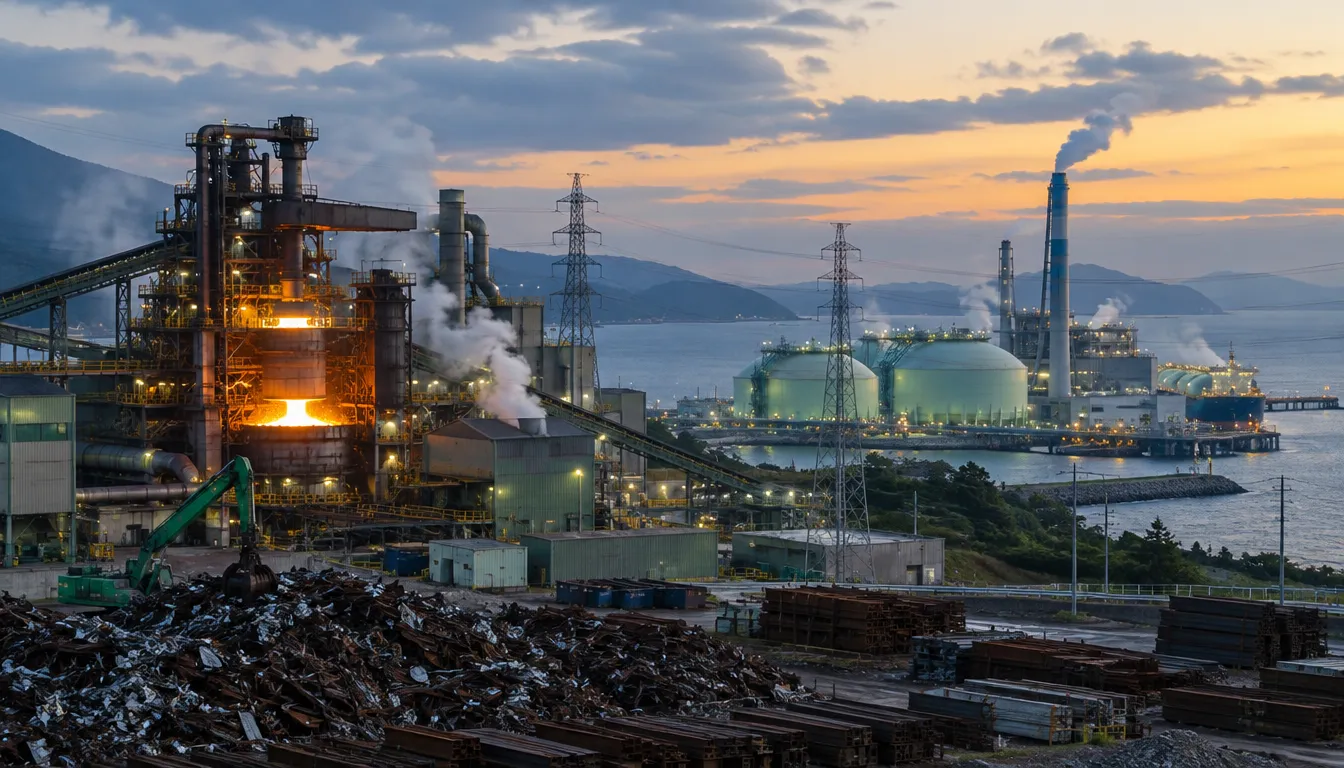
A Transition Asia analysis finds Nippon Steel’s planned Yawata electric arc furnace would still emit about 278 kg of CO2 per tonne of steel, against an IEA near-zero benchmark of roughly 110 kg.
Nippon Steel’s planned electric arc furnace at Yawata would produce steel at about 278 kg of CO2 per tonne, according to a report published on 19 October by think tank Transition Asia. That figure assumes the furnace runs on the company’s own gas-fired power plant. The report sets it against an International Energy Agency (IEA) near-zero benchmark of about 110 kg for the same scrap share. It also finds that a ¥40 billion annual green-steel tax credit would pay out whatever the power source.
Transition Asia is a non-profit think tank founded in 2021. It works on decarbonising heavy industry across Asia in line with the 1.5°C goal. Dr Liying Qiu and Akira Kanno wrote the analysis.
The Yawata plan
Nippon Steel plans a 2 million tonne electric arc furnace at Yawata. The furnace would draw power from a 2 GW captive liquefied natural gas (LNG) plant from 2031. The report says the LNG contracts for that plant are not yet signed. It describes Japan as being in its third gas crisis in five years, with the country spending about ¥25 trillion a year on imported fossil fuels.
Steelmakers are replacing blast furnaces with electric arc furnaces. That shift makes the source of their electricity the main driver of both emissions and exposure to gas price shocks, the analysts argue.
Price and supply risk
The authors compare the Yawata route with buying grid power and renewable contracts. They use real prices from 2020 to mid-2026 and run 4,000 simulated futures for 2029 to 2045. Their central case assumes 58% plant efficiency and 650 kWh of electricity per tonne of steel. It uses an exchange rate of ¥150 to the dollar and an LNG mix of 44% oil-linked, 36% US-gas-linked and 20% spot.
Power cost per tonne of steel reached about ¥30,600 at the 2022 spot LNG peak, against about ¥6,400 in normal conditions. At the March 2026 spot peak of $24.8 per million British thermal units, it reached about ¥15,800. The plant’s share of shared LNG tanks would cover about 11 days of fuel, while documented LNG supply outages have lasted from two to 26 months.
Oil-linked contracts were 35% cheaper than spot-exposed supply in 2022. The gap narrowed to 26% in the first half of 2026.
Cost and carbon
Including capital, the LNG plant would cost about ¥95 billion a year. Buying the same electricity at Kyushu spot prices would cost about ¥114 billion to ¥131 billion, so the captive plant is cheaper today. In a one-in-20 bad gas year, costs would rise by about ¥16 billion. The report puts that at roughly 1% of Nippon Steel’s cash and credit lines and calls it a margin risk with no threat to solvency.
Carbon is where the comparison turns. The Kyushu grid is projected to fall below the plant’s emissions factor of 0.359 kg CO2 per kWh in 2030 and to reach about 0.065 by 2040. The plant is planned to run until about 2056. Even with full hydrogen co-firing, cumulative emissions would be 1.7 times those of the grid route, the report finds.
In 2040 the plant would emit 4.4 million tonnes of CO2. That would cost about ¥30 billion a year at current-policy carbon prices, or ¥136 billion on the IEA Net Zero path.
The tax credit and the recommendations
The ¥40 billion green-steel tax credit rewards the switch to an electric furnace and ignores the power source behind it. Japan’s trade ministry has already made electric arc furnace steel a priority, as its JPY 1.26 trillion budget request showed.
Transition Asia asks steelmakers to benchmark new furnaces against the grid route. It asks investors to price carbon costs and the combined risk of fuel and steel downturns. It asks policymakers to direct new furnaces towards clean power. It also wants a carbon-intensity condition on the tax credit and no free allocation under the GX-ETS for new captive fossil generation.
The report urges funding for clean power that industry can buy around the clock, such as storage, wind and grid upgrades. It sets that against fuel subsidies of about ¥1 trillion a year plus a ¥2.5 trillion reserve. It also calls for environmental reviews to assess new captive plants against the grid as well as against coal.
