


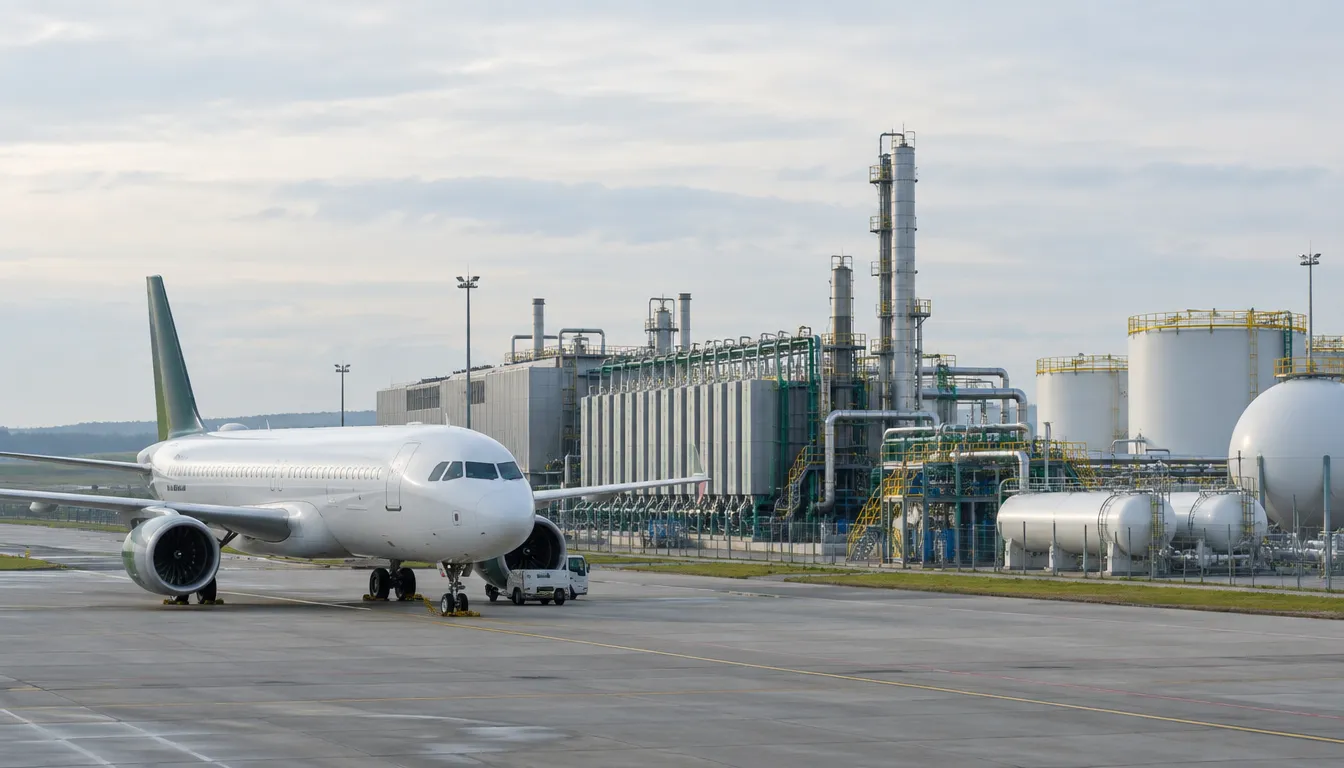
Germany, Austria and Luxembourg will provide up to €2.12bn through a joint eSAF funding scheme, using a double-sided auction to bridge the price gap between buyers and sellers of electricity-based aviation fuel.
Germany, Austria and Luxembourg announced on 21 September a joint eSAF funding scheme worth up to €2.12 billion. The three governments will run a shared auction to bring together buyers and sellers of electricity-based sustainable aviation fuel, with public money bridging the price gap. Germany will provide up to €2 billion, while Austria and Luxembourg will each provide up to €60 million.
The scheme targets a structural problem in the market. Producers of eSAF, also known as power-to-liquid fuel, need long-term offtake agreements to secure investment decisions. Airlines and fuel buyers typically sign aviation fuel contracts over much shorter periods. That mismatch leaves plants without the revenue certainty that lenders and developers ask for before committing capital.
How the double-sided auction works
Under the mechanism, bids from eSAF producers and demand from buyers will be set through competitive bidding. Government subsidies will then cover the difference between the price producers need and the price buyers will pay. The design gives producers a route to a long-term buyer and gives airlines access to supply at a price they can accept.
The three countries will share out the subsidised fuel in proportion to their funding. Each country will place its share of the eSAF volumes on its own market. On the announced figures, Germany’s €2 billion is about 94% of the €2.12 billion total, so it would take most of the fuel. Austria and Luxembourg would each take roughly 3%. The announcement does not say how many tonnes of eSAF the funding will buy or when the first volumes will reach the market.
The governments are founding members of the eSAF Early Movers’ Coalition, which launched in December 2025. The coalition aims to speed up the market ramp-up of eSAF in Europe through cooperation, exchange of experience and joint financial support.
Why eSAF needs public support
eSAF is made from renewable hydrogen, produced by electrolysis with renewable electricity, combined with carbon. Because it does not depend on waste oils or agricultural residues, it offers a route around the feedstock limits that constrain conventional sustainable aviation fuel. Conventional fuel of this type is generally produced from sustainable resources such as waste oils and agricultural residues, and is seen as one of the key tools to decarbonise aviation in the near to medium term. Production plants for eSAF nonetheless need substantial investment before they can deliver at scale.
The International Air Transport Association (IATA) has reported that sustainable aviation fuel production nearly doubled in 2025, yet it supplied only 0.6% of airlines’ total fuel consumption. Fuel accounts for the vast majority of the aviation sector’s emissions, so the low share shows how far supply must grow. Barriers include high initial costs and feedstock constraints, and a July report on production lagging policy ambitions points the same way.
Steffen Bilger, Germany’s Federal Minister of Transport, said: “When it comes to eSAF, Europe needs not only ambitious targets but also investment in industrial production. Germany, Austria and Luxembourg are jointly demonstrating how European cooperation works in practice. We are pooling our funding to create better conditions for investment decisions in a technology of the future.”
What the eSAF funding scheme means for developers
The eSAF funding scheme gives project developers a defined public funding pool and a competitive process to work within. The announcement does not set out the auction timetable, the bidding rules or any price ceilings, so developers cannot yet model their bids. Those details will decide how many projects can qualify and how much subsidy each one receives.
For airlines and fuel suppliers, the scheme offers a way to secure early volumes of eSAF at a subsidised price. For investors, the combination of a long-term buyer and state support may reduce revenue risk on first-of-a-kind plants. The eSAF funding scheme will show how much production Europe can bring forward once the auction opens.
