


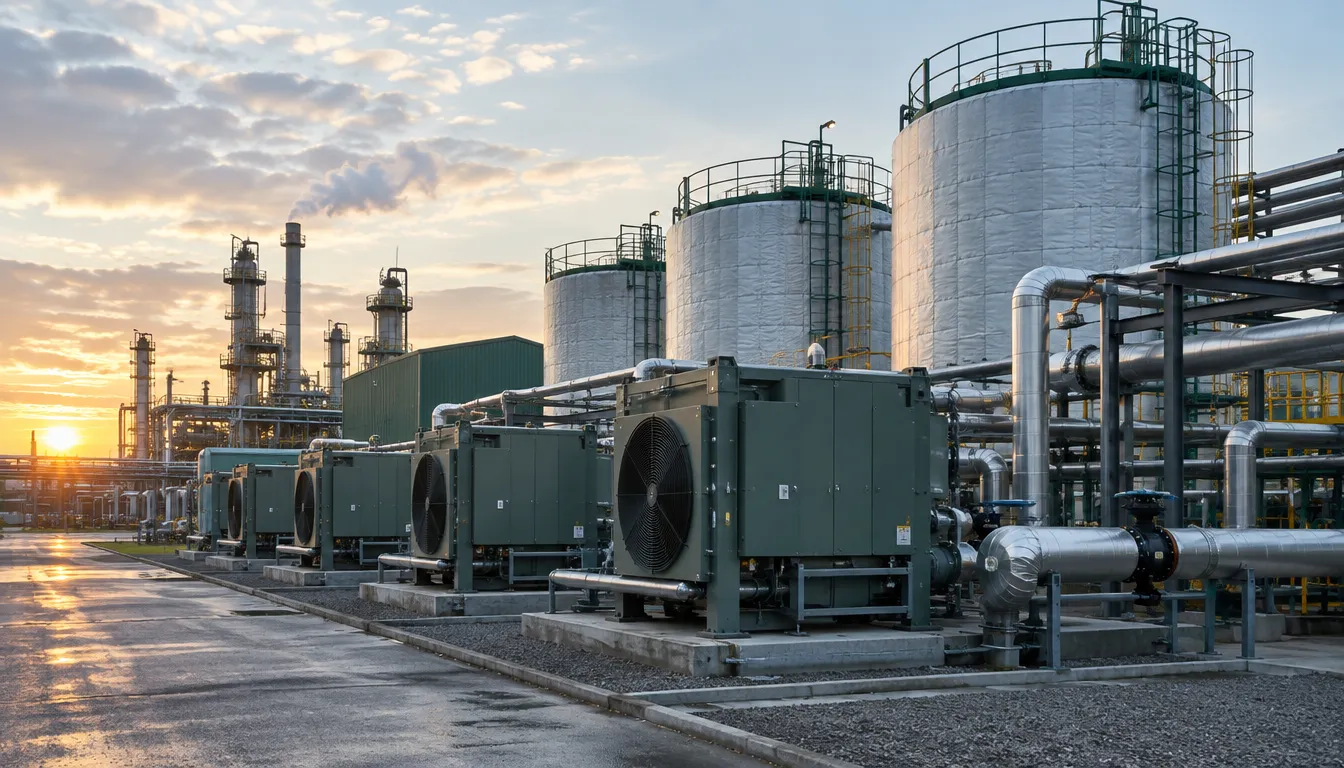
The Commission has published final terms for its second industrial heat auction, releasing €1 billion from EU Emissions Trading System revenues to cut fossil fuel use in process heat, with bidding expected from December.
The European Commission published the final terms and conditions on 24 September for its second Europe-wide industrial heat auction, known as the IF26 Heat Auction. The auction has a planned budget of €1 billion from EU Emissions Trading System (EU ETS) revenues. Bidding is expected to open in early December 2026, so applicants have roughly two months to prepare their bids.
Process heat is the energy used to reach the high temperatures that manufacturing needs. The Commission says these processes are largely powered by fossil fuels and account for three-quarters of industrial emissions. Chemicals, pulp and paper, steel, food and drink, and cement all rely on them, and every industrial sector can take part. The industrial heat auction therefore targets one of the largest single sources of industrial carbon dioxide in the bloc.
How the subsidy works
Successful bidders receive a fixed premium subsidy. The payment is linked to each tonne of direct carbon dioxide (CO2) emissions that a project abates, and it runs for a maximum of five years. The auction is open to projects of all sizes from every industrial sector across the European Economic Area. The Commission says it suits projects with continuous industrial processes, and it also rewards flexibility solutions that avoid electricity use in peak hours or use technologies that need no electricity.
Member States can add money. National contributions may top up the auction through Auction-as-a-Service, an approach that has already worked in earlier rounds under the European Hydrogen Bank. The Commission prepared the final terms after public consultations with industry and other stakeholders. The full terms and conditions document sets out the requirements in detail.
Technologies and eligibility
The IF26 Heat Auction supports three categories of technology. Electrified options include heat pumps, thermal storage, plasma torches and electric boilers. Direct renewable heat covers solar thermal and geothermal sources. For the first time, nuclear technologies such as small modular reactors can also compete. The Commission says the auction is designed to close the cost gap between these options and fossil fuel-based heat.
Eligibility is wider than in the first round. The second industrial heat auction admits projects producing heat above 80ºC, where the earlier round covered only heat above 100ºC. The design also gives further incentives to flexibility solutions that reduce pressure on the electricity system.
Link to the Industrial Decarbonisation Bank
The auction follows the first round, IF25, which selected 65 projects. Both auctions act as pilots for the Industrial Decarbonisation Bank, which is meant to provide €100 billion in funding for industrial decarbonisation. The Commission announced the auction in the Clean Industrial Deal, saying it will “boost investment in homegrown clean energy solutions”.
Manufacturers are already turning their attention to heat. Sanofi, UCB and Opella recently joined a pharma industrial heat programme, which shows how far the topic now reaches into regulated sectors. The new auction gives projects of that kind a route to public support for the capital cost of switching fuels.
The Commission is running information webinars on the industrial heat auction through October to help applicants. Sessions start on 1 October for Ireland and 5 October for Romania, followed by Spain on 6 October and the Nordic countries on 7 October. Germany and Austria follow on 13 October, the Benelux countries on 20 October, Czechia and Slovakia on 27 October, Italy on 29 October and France on 30 October. Applicants can send questions to [email protected].
For industrial emitters, the practical step is to review the requirements now. Publication of the terms lets applicants check the rules against their project pipelines before the bidding window opens in early December. Operators with heat pump, thermal storage, direct renewable or nuclear heat projects can compare their cost gap with the five-year fixed premium. The Commission links the scheme to its goal of climate neutrality by 2050 and to lower energy prices, and the industrial heat auction is the second test of that approach after IF25.
