


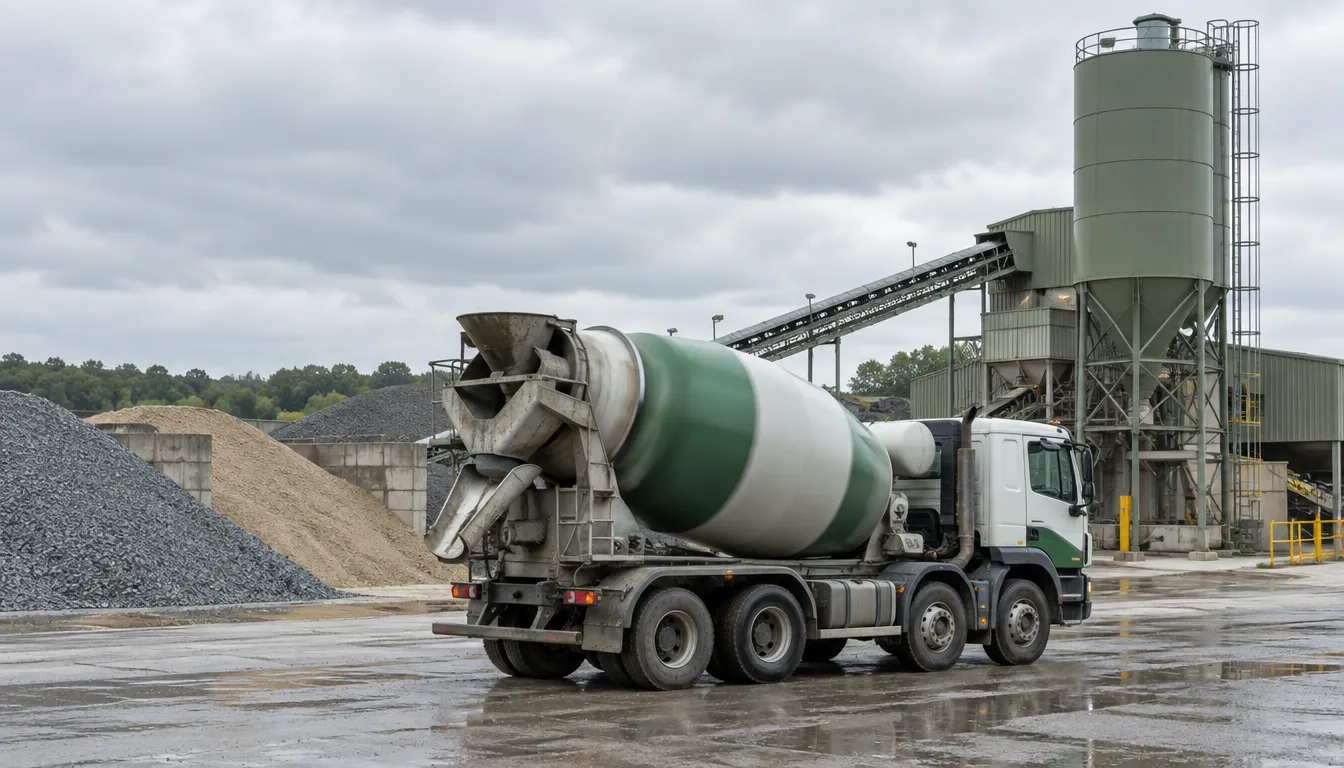
Average concrete embodied carbon in UK ready-mixed supply fell about 5% in 2025, the latest industry benchmark shows, as Portland-limestone cements gained ground after a 2023 revision to the British Standard for concrete.
Average concrete embodied carbon in the UK fell by about 5% in 2025, according to the Low Carbon Concrete Group (LCCG) Market Benchmark published by The Concrete Centre. The volume-weighted average for ready-mixed concrete dropped from 242 kgCO2e per cubic metre in 2024 to 229 kgCO2e per cubic metre in 2025. That is a cut of 13 kgCO2e for every cubic metre poured.
What the benchmark measures
The benchmark draws on data covering more than half of UK ready-mixed concrete production. It measures normal-weight concrete across raw material extraction, transport and production up to the batching plant. The LCCG first published the benchmark in 2022, and this is its fifth annual edition.
Clients, designers, contractors and suppliers use it to compare concrete embodied carbon by strength class. They can then set reduction targets against a shared baseline rather than against supplier claims alone. The 2025 figures give the market a fresh reference point for that exercise.
The scope runs up to the batching plant, so the numbers describe the product as it leaves the gate. Measured against the 2024 average, the 13 kgCO2e fall equals about 5.4%, which the benchmark reports as roughly 5%. Because the data covers a large share of UK output, the average reflects much of the market, although it cannot describe every plant or mix design.
Portland-limestone cement drives the fall
The LCCG attributes the reduction mainly to wider use of Portland-limestone cements. Producers could use these after the 2023 revision to BS 8500, the British Standard for concrete. Portland-limestone cement carries a larger share of ground limestone and less clinker. Clinker production is the most carbon-intensive step in making cement, so each tonne of cement then carries a lower footprint.
Andrea Charlson, Head of Sustainability at UK Concrete and The Concrete Centre, said the progress reflects “the increased use of lower-carbon materials”. She described the move to Portland-limestone cements as a significant transition for the industry. Charlson also cautioned that average concrete embodied carbon remains above the targets linked to the UK’s industrial decarbonisation strategy.
Part of a longer cut in sector emissions
The improvement sits within a longer trend. The UK concrete and cement sector has achieved a 63% emissions reduction since 1990. It credits technology, better energy efficiency and fuel switching to waste-based alternatives for that result. The 2025 benchmark adds a product-level view of concrete embodied carbon to those sector-wide numbers, and it lets buyers see where the average now sits.
Helen McGarry, Associate Engineer and Sustainability Lead at Design ID and an LCCG member, pointed to the value of a fifth annual benchmark. In her view, a stable baseline lets project teams measure improvement in line with PAS 2080 principles. PAS 2080 is the British specification for managing carbon in buildings and infrastructure.
The figures describe carbon intensity per cubic metre. They do not show total emissions from the sector, which also depend on how much concrete the UK builds each year. A lower intensity still cuts emissions on every project that specifies the newer mixes, but total output will shape the overall result.
Other markets are working on similar problems. In the United States, the American Cement Association recently moved to unify cement embodied carbon reporting. Cemvision and S:t Eriks have partnered to bring near-zero carbon concrete to market. Both efforts show the same priority as the LCCG benchmark: reliable measurement of concrete embodied carbon comes first.
For specifiers and procurement teams, the 2025 data sets a clear reference for concrete embodied carbon. A mix at or below 229 kgCO2e per cubic metre now matches or beats the market average. Buyers who want to reach the targets Charlson cited will need further reductions beyond what Portland-limestone cement delivers on its own.
