


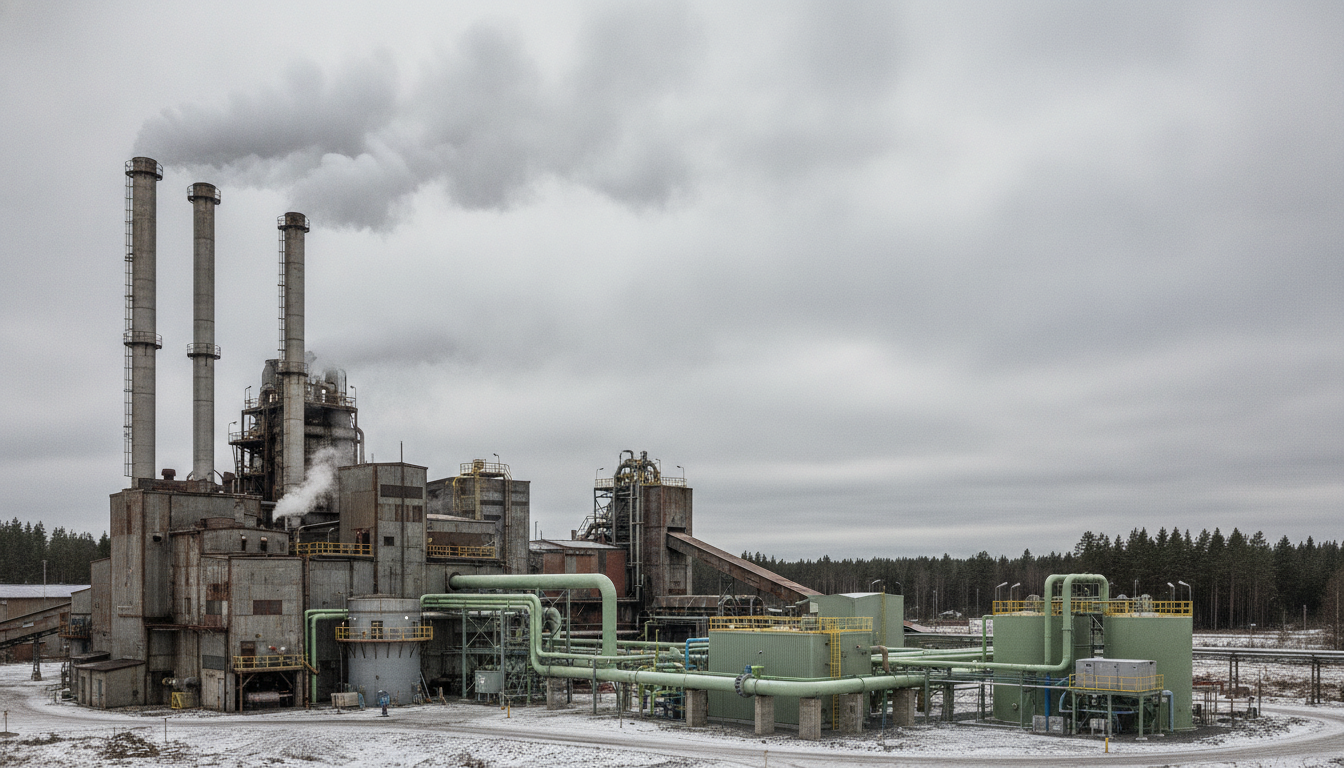
Finland’s Ministerial Finance Committee has cleared €21m in funding for a biogenic carbon capture plant at Metsä Fibre’s Rauma pulp mill, backing a €70m project designed to supply CO2 for renewable electrofuels production.
Finland’s Ministerial Finance Committee has approved €21m in state funding for a biogenic carbon capture plant at Metsä Fibre’s pulp mill in Rauma. The Ministry of Economic Affairs and Employment will now prepare the formal funding decision. It goes to Sari Multala, Finland’s Minister of Climate and the Environment, for final sign-off.
The plant is expected to cost €70m ($81.2m) in total. It would have capacity to capture 100,000 tonnes of CO2 a year. That CO2 would come from the flue gases of Metsä Group’s Rauma pulp mill. Burning wood-based biomass produces the biogenic CO2. Operators would then deliver it onward to make renewable electrofuels, rather than release it to the atmosphere.
Electrofuels, also known as e-fuels or power-to-x fuels, combine hydrogen made through electrolysis with a carbon source, typically CO2. The result is a synthetic fuel that can substitute for fossil equivalents in shipping, aviation and other hard-to-abate transport. Biogenic CO2 lowers the fuel’s net carbon footprint compared with a fossil source. That is one reason capture plants at biomass-fired sites like pulp mills are attracting funding interest.
Ministerial Finance Committee clearance is a preliminary step in Finland’s funding process. It comes ahead of the ministry’s formal decision and sign-off by the responsible minister. Gasworld reported that the committee’s approval opens the way for the funding decision to be finalised. The plant still needs the minister’s formal go-ahead.
Finland channels state funding into industrial decarbonisation projects through this committee process. Officials screen funding decisions before they go to the relevant minister for formal approval. Backing for carbon capture, hydrogen and low-carbon fuel projects forms part of a wider push. Finland is working to cut emissions from energy-intensive industry.
Metsä Fibre operates the pulp mill at Rauma, on Finland’s south-west coast. It is part of the Finnish forest industry group Metsä Group. The capture plant would sit alongside the mill’s existing pulp production. It would draw on CO2 already generated by burning biomass for process energy.
Biogenic CO2 capture is drawing growing interest across the Nordic pulp and paper sector. Mills there already burn biomass for process heat. That produces a CO2 stream treated as carbon-neutral under EU accounting rules. Capturing that stream gives producers a route to supply CO2 as feedstock for synthetic fuels and other power-to-x applications, instead of venting it.
Pulp and paper is one of several hard-to-abate sectors that combines high process heat demand with an on-site biomass fuel supply. That combination makes it a natural early testing ground for carbon capture technology. Finland’s move follows a wider pattern of European governments backing capture projects at biomass and waste-fired plants. They are looking for lower-cost routes to carbon-neutral and negative-emissions fuel supply.
Metsä Fibre said the approach used at Rauma could be scaled up and repeated at other sites, according to gasworld. For pulp and paper producers weighing similar investments, the project is an early test. It shows whether biogenic capture can move from single pilot plants to a repeatable model. It will also test whether the captured CO2 can find a reliable buyer in the emerging electrofuels market.
