


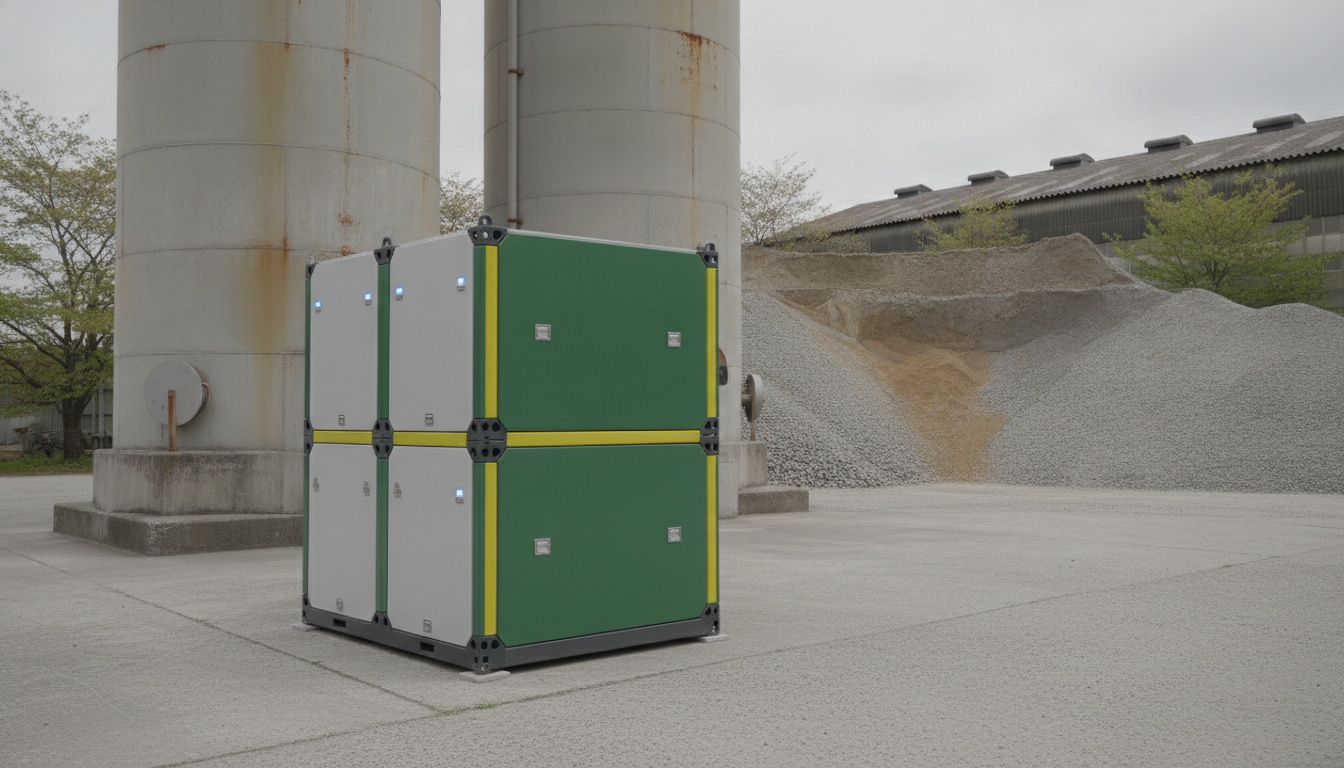
Aircapture and NGK have commissioned a direct air capture unit at AIZAWA Concrete’s Fukushima site, testing NGK ceramic substrates in commercial conditions and looking at concrete mineralisation as an outlet for the captured gas.
Aircapture and NGK Corporation have started a joint direct air capture demonstration at AIZAWA Concrete Corporation’s site in Fukushima, Japan. Aircapture designed the system around NGK’s ceramic substrates, then supplied and commissioned it to AIZAWA Concrete.
The project sits at AIZAWA Concrete’s Fukushima RDM Center. It will evaluate the system’s performance, operational characteristics and durability while running in real-world operating conditions. For Berkeley-headquartered Aircapture the deployment is its first in Japan. For NGK it is the first direct air capture demonstration in a commercially operating environment.
Capture tied to an industrial outlet
The two companies will use the deployment to explore utilisation pathways for the captured carbon dioxide, including concrete mineralisation. Storage is the usual destination for captured gas, and it needs pipelines or shipping to reach a reservoir. Mineralising the gas into concrete made on the same site removes that step.
Mineralisation binds carbon dioxide into carbonate within the concrete, so the gas ends up in a product instead of a reservoir. For a concrete producer that removes the need for storage infrastructure and attaches an emissions claim to material it already sells.
Ceramics against the energy bill
NGK’s contribution is the substrate that carries the sorbent. The companies expect the pairing to give more efficient atmospheric carbon dioxide capture and more compact system configurations. They also expect lower blower energy consumption through a reduced pressure drop, and lower regeneration energy through reduced thermal capacity.
Those two energy terms dominate the running cost of direct air capture. Carbon dioxide is dilute in air, so very large volumes have to be moved through the contactor, and the sorbent then has to be heated to release what it has caught. A lower pressure drop cuts the fan work. A substrate with less thermal mass wastes less heat warming the structure rather than the sorbent.
Matt Atwood, founder and chief executive of Aircapture, said almost all of Japan’s industrial carbon dioxide today comes from fossil-based processes, and that the country’s 2050 carbon neutrality target will require phasing that supply out. He noted that no plan is currently in place to replace it.
“That is why we prioritized Japan as an early market,” Atwood said. “In this demonstration, we installed NGK’s ceramic substrate in a working Aircapture system to test its performance under real conditions, not only in the lab. What we learn here will support our plan to commercialize DAC in Japan.”
Motoo Noritake, senior vice president and group executive of NGK’s Environment Business Group, said: “Through this demonstration with Aircapture and AIZAWA Concrete, we will accelerate efforts toward the practical deployment of DAC systems.”
The companies expect the work to support lower overall system costs, wider deployment of modular direct air capture and more carbon dioxide utilisation opportunities.
On Atwood’s account, an industrial market already buying fossil-derived carbon dioxide gives direct air capture a commercial route in Japan that does not rest on removal credits alone. The demonstration will not settle the economics. It will produce durability and energy data from a working concrete plant, which is what a supplier needs before it can quote a commercial unit.
