


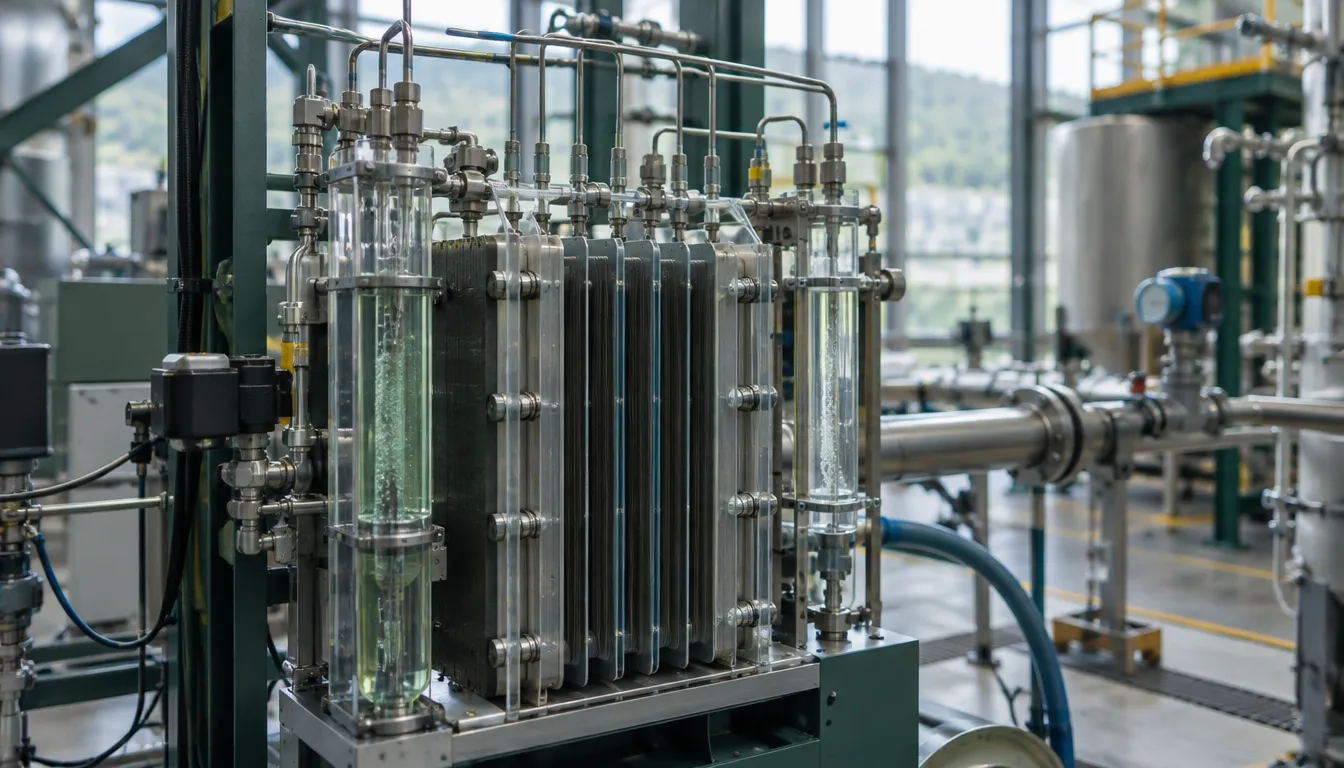
Researchers at Johns Hopkins University have built an electrochemical carbon capture system that swaps costly ion-exchange membranes for solid electrodes, cutting projected capture costs by 28.9% and running for 350 hours without degrading.
Engineers at Johns Hopkins University have built an electrochemical carbon capture device without the ion-exchange membrane used in most designs of its kind. The work is described in Nature Chemical Engineering. Their techno-economic analysis puts the projected capture cost 28.9% below that of an equivalent membrane-based system.
The device is a form of electrochemically mediated carbon capture. This technology uses electricity, rather than heat, to bind and release carbon dioxide from a sorbent. Most versions rely on an ion-exchange membrane to keep the two electrode compartments separate while still letting charge-carrying ions pass through. That membrane is one of the more expensive parts of the cell, and it adds resistance that limits performance.
The team was led by Andong Liu, with senior author Yayuan Liu of the university’s Department of Chemical and Biomolecular Engineering. They replaced the membrane with a solid-state counter-electrode made from sodium iron phosphate. It is paired with an azopyridine sorbent at the working electrode. Removing the membrane cuts both material cost and cell complexity, the researchers said.
Ion diffusion, not thermodynamics, sets the pace
A central finding of the study concerns self-discharge, the rate at which a capture cell loses carbon dioxide it has already bound while sitting idle. The team found that this rate is governed by kinetic factors, particularly how fast ions diffuse through the solid-state electrode, rather than by the thermodynamic driving forces of the reaction. That result gives developers a concrete property, ion diffusivity, to screen for when choosing electrode materials for future systems.
In laboratory testing, the membraneless cell completed 75 capture-and-release cycles over 350 hours without a meaningful drop in performance. It kept operating at high current density, with dilute carbon dioxide feeds and in the presence of oxygen. Those conditions sit closer to industrial flue gas than the purified gas streams often used in early-stage laboratory demonstrations. Oxygen tolerance is important for a capture system aimed at real exhaust streams. Many organic sorbents used in electrochemical capture degrade on contact with oxygen, forcing earlier designs to strip it out of the feed before capture can begin.
The work builds on earlier research from the same group. In 2024 Andong Liu led a separate study, published in Nature Energy, on an oxygen-tolerant electrochemical capture system that used a Nafion membrane. “Carbon capture technologies that use thermal chemistry are well developed and some have already been commercialised, but those methods are pretty energy consuming,” Liu said of that earlier work, in comments reported by Johns Hopkins’ engineering school. “When your method for capturing carbon is driven by electricity, you don’t use nearly as much energy.”
The new study was funded by the US National Science Foundation, under award number 2237096, and the David and Lucile Packard Foundation.
Electrochemically mediated carbon capture remains a laboratory-stage technology. The 28.9% cost reduction is a modelled projection, not a figure from a built plant. Industrial operators and investors weighing capture routes for hard-to-abate sectors such as steel, cement and chemicals will still be watching for membraneless designs to clear pilot-scale testing. That is where material costs and durability claims get tested against real flue gas over periods longer than 350 hours.
