


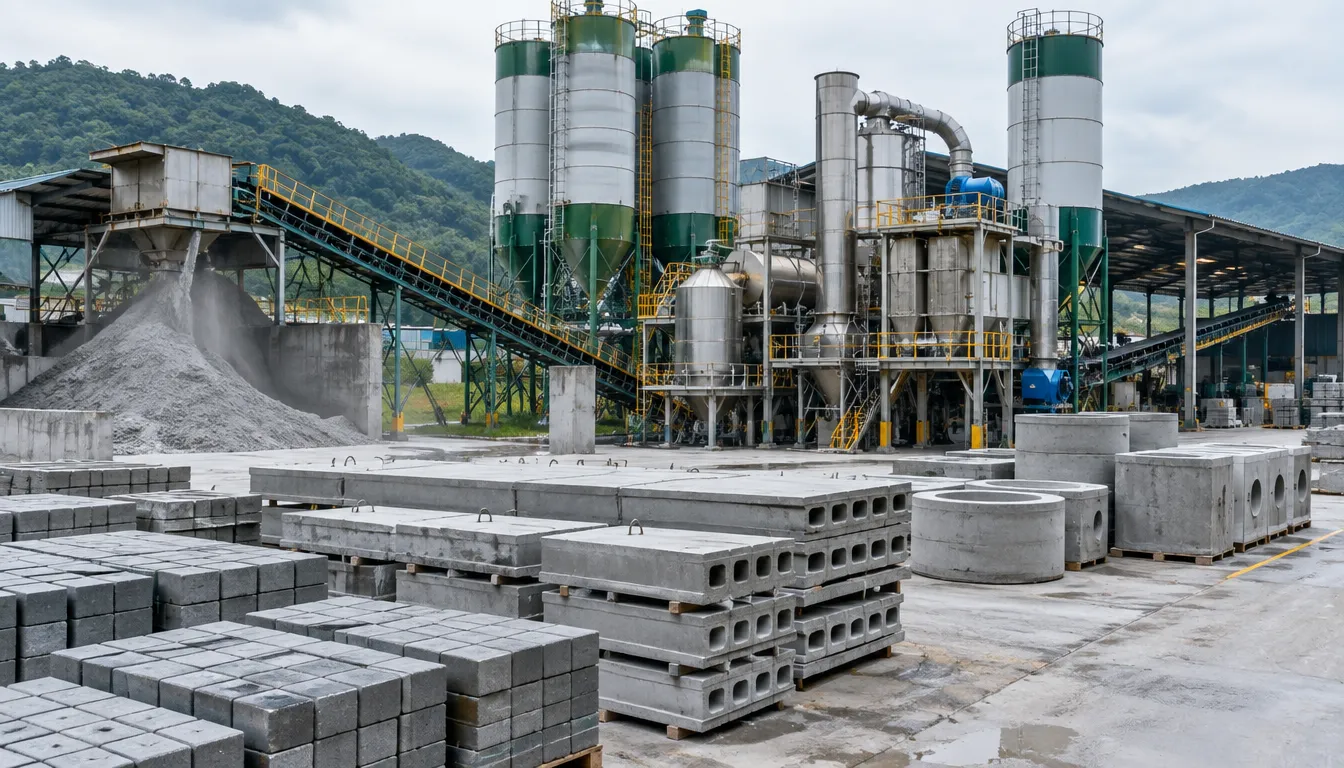
China’s CESTRI has opened a demonstration plant that turns coal fly ash into fly ash geopolymer concrete, a cement-free binder the institute says cuts emissions and costs against Portland cement.
The CHN Energy Science and Technology Research Institute (CESTRI) has opened a demonstration base in China that converts coal fly ash into fly ash geopolymer concrete, a cement-free binder developed with CHN Energy’s Anqing Power Plant. The 6,200 square metre facility combines raw material storage, preparation, testing and engineering validation on one site, taking the process from laboratory work to a scale that can supply real construction projects rather than test batches alone.
Demonstration plants of this kind are typically the step between a laboratory result and a commercial production line, and are where a process either proves it can hold to spec at volume or reveals problems that only show up outside the lab.
The core process converts Grade II fly ash, a fine residue from coal-fired power stations, into a fly ash geopolymer concrete binder that uses no Portland cement. Fly ash accounts for 50% to 70% of the material, replacing the clinker that gives conventional cement most of its carbon footprint. Clinker production requires limestone to be heated to around 1,450°C, a step that releases CO2 both from the fuel burned and from the limestone itself, which is why cutting clinker content tends to cut emissions directly.
CESTRI says the fly ash geopolymer concrete binder cuts carbon emissions by around 80% compared with conventional Portland cement, while costing 10% to 30% less than comparable cement products. The resulting concrete can be produced in strength classes from C15 to C50, a range that covers everything from paving and precast blocks to structural applications, according to the institute. That spread matters for adoption, since it lets the same base material serve low-strength paving and higher-strength structural work without a separate production line.
Products made with the geopolymer binder are already used in roads, precast components and paving blocks. Third-party testing found they met relevant Chinese standards, CESTRI said. The institute has filed more than 10 patent applications tied to the process, and two group standards covering the material have been approved for development.
That step sets the specifications contractors and regulators can build against before wider commercial rollout. Standards of this kind are usually the slowest part of bringing a new construction material to market, since procurement teams are reluctant to specify a binder with no agreed test method behind it.
Cement is one of the hardest industrial sectors to decarbonise. Most of its CO2 comes from calcining limestone into clinker rather than from the fuel that heats the kiln, so switching fuels alone cannot close the gap. Fly ash geopolymer concrete is one of several routes producers are testing to cut that footprint, by replacing clinker with an industrial by-product instead of burning it more cleanly.
For CHN Energy, one of China’s largest coal generators, using fly ash this way also addresses a long-running disposal problem, since ash ponds and stockpiles remain an environmental liability at coal plants across the country, and a market for the material turns a waste stream into a saleable product.
The project follows other efforts to commercialise cement-free binders. In Ireland, developers unveiled a cement-free 3D-printed geopolymer that promised a 70% cut in embodied carbon, using a different feedstock but the same basic principle of activating an industrial residue instead of firing new clinker. Fly ash geopolymer concrete projects tend to be judged on the same measures CESTRI has published figures for: the carbon reduction claimed against Portland cement, the cost difference, and the strength classes the material can reach once it is out of the laboratory.
CESTRI’s base will extend its research beyond binders into stabilised soil, ecological backfilling and thermal energy storage materials, broadening the range of applications for coal by-products beyond construction. For cement producers and industrial emitters more widely, the demonstration adds a commercially priced, third-party tested example to a still-small pool of geopolymer alternatives to clinker-based cement, and shows a route for coal generators to turn a legacy waste stream into a saleable material rather than a long-term liability.
