


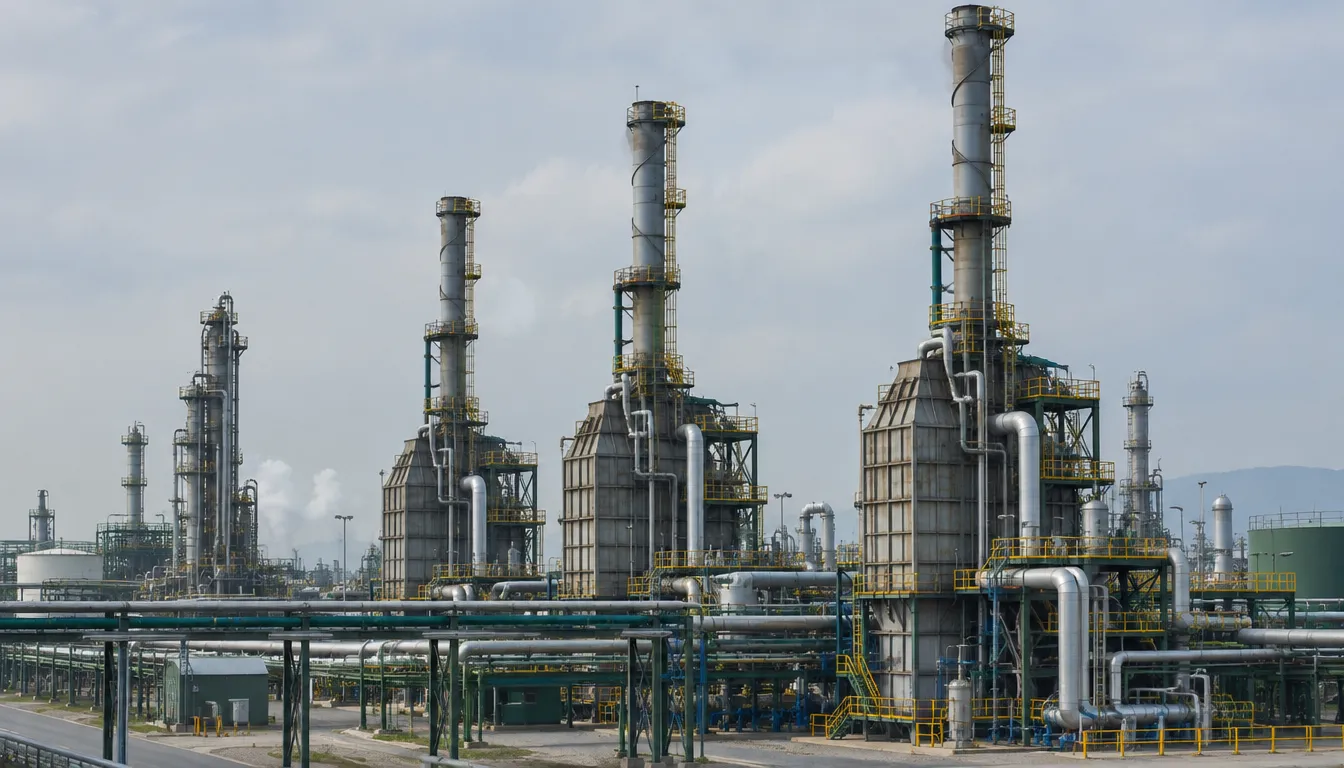
NEDO and four Japanese partners achieved 85% ammonia co-firing in a full-scale naphtha cracking furnace, a step towards decarbonising petrochemical production without a full plant redesign.
A Japanese consortium has achieved an 85% ammonia co-firing rate across a full-scale naphtha cracking furnace, a milestone the group says clears one of the toughest technical barriers to decarbonising petrochemical production.
NEDO, Japan’s New Energy and Industrial Technology Development Organization, ran the demonstration together with Mitsui Chemicals, Maruzen Petrochemical, Toyo Engineering and Sojitz Machinery, testing a furnace fitted with a newly developed ammonia-fired burner. The 85% figure covers the entire furnace on a heat-input basis, which the consortium describes as a world-class result.
Naphtha cracking furnaces heat naphtha derived from crude oil to produce ethylene, propylene and other basic petrochemicals used across plastics, synthetic fibres and rubber. They typically burn off-gas made mostly of methane, and the combustion involved makes them one of the largest sources of carbon dioxide at petrochemical complexes. Switching that fuel to ammonia, which releases no carbon dioxide when it burns, offers one of the more direct routes to cutting emissions from a process that plastics and chemicals producers otherwise find hard to decarbonise. Ammonia also has an advantage electrification lacks in this setting: cracking furnaces need very high, steady combustion temperatures that are difficult to reach with electric heating at the scale a commercial petrochemical complex requires, making a fuel swap more practical than a switch to electric furnaces in the near term.
Reaching a high ammonia co-firing rate is harder than simply swapping fuels. Ammonia burns more slowly than methane and produces nitrogen oxide emissions during combustion, so any furnace running on it needs to manage stable combustion, even heat transfer to the cracking tubes, and NOx control all at once. The consortium says it held NOx emissions at levels comparable to existing commercial furnaces while reaching the 85% co-firing rate, addressing the trade-off that has limited ammonia’s use in this kind of equipment until now.
The project, under way since the 2021 fiscal year as part of NEDO’s Green Innovation Fund, developed two types of ammonia-fired burner for the demonstration. Hearth burners, which provide the furnace’s main heat input, ran on 100% ammonia throughout the test. Wall burners, used to shape the flame and even out temperature across the furnace, continued running on off-gas methane, with ammonia use in those burners planned for a later phase. Because the hearth burners carried the bulk of the heat load, running them entirely on ammonia was enough to lift the whole furnace to an 85% ammonia co-firing rate.
NEDO and the four companies said they will now work on extending ammonia use to the wall burners, with the explicit goal of reaching 100% ammonia firing across the entire furnace. No timeline for that next phase has been disclosed. Extending full ammonia firing to the wall burners is likely to be the harder half of the task, since those burners exist specifically to fine-tune flame shape and temperature distribution rather than to deliver bulk heat, a role ammonia’s slower combustion characteristics make more difficult to fill.
The result adds a petrochemical application to a growing list of ammonia co-firing projects across Japanese industry, following moves in ammonia cracking for industrial fuel switching elsewhere and in power generation, where utilities have already trialled ammonia co-firing in coal plants. Petrochemical complexes have generally lagged behind those sectors because cracking furnaces impose tighter combustion and heat-transfer requirements than a boiler burning a single fuel at steady load.
For petrochemical operators watching Japan’s programme, the demonstration suggests ammonia co-firing is now close enough to commercial reliability to justify pilot investment, even if full ammonia firing across an entire furnace remains a further step away. Mitsui Chemicals and its partners have not said when the technology might move from demonstration to a working commercial furnace. Given how few plants have attempted ammonia co-firing at this scale, the wider petrochemical sector is likely to watch this project closely before committing capital of its own.
