


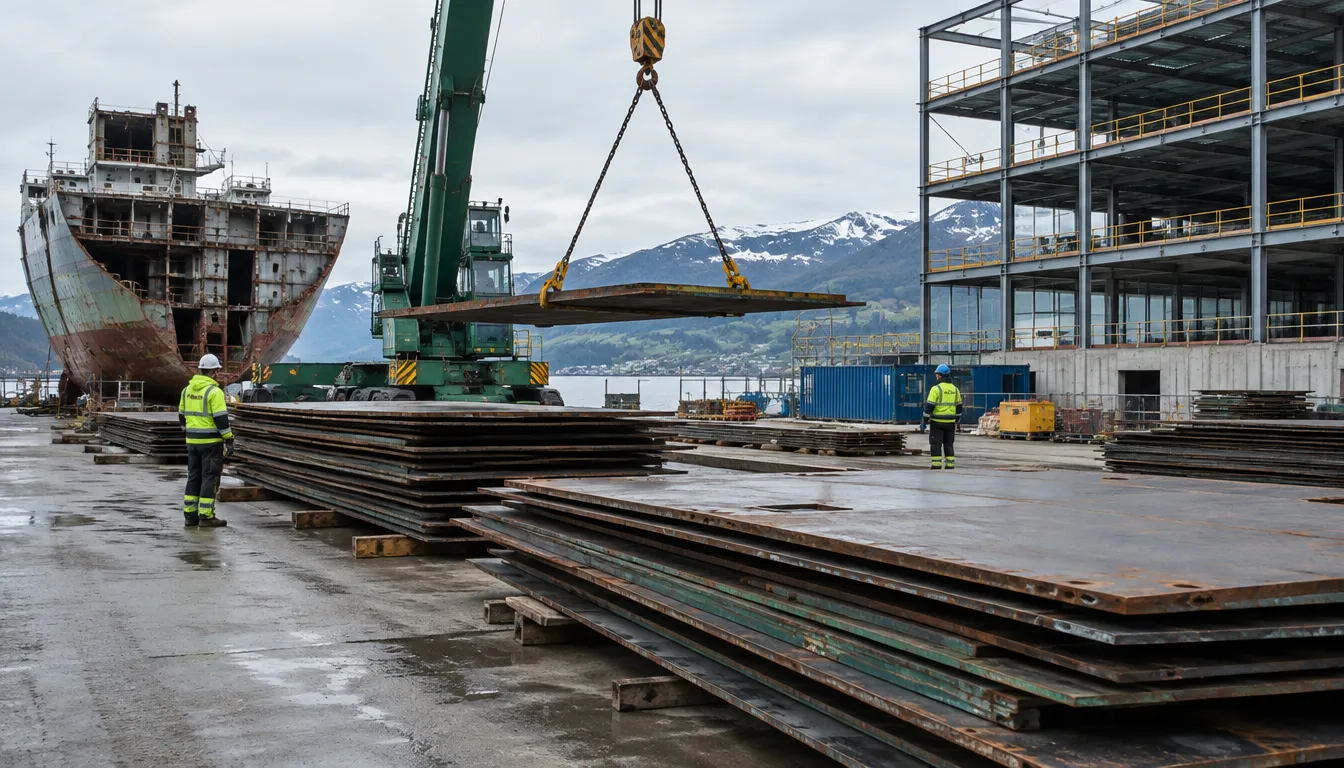
Norwegian agency Enova plans up to NOK 244 million for ship steel reuse in new buildings, a project that could cut construction emissions by up to 25% and give Europe a circular steel supply chain.
Norwegian state agency Enova plans to provide up to NOK 244 million ($25.54 million) to Nordic Circles and Alsaker Stål. The money would back ship steel reuse in new buildings. Enova says the route could cut greenhouse gas emissions from building construction by up to 25%.
The funding is conditional on the project going ahead. It would support a circular steel value chain in Norway. The chain covers recovering steel from decommissioned vessels, cleaning it, assuring its quality and recertifying it for construction use.
Alsaker Stål, which is part of Tertnes Holding, plans to invest up to NOK 520 million ($54.44 million) in cooperation with Nordic Circles and Enova. The company is therefore prepared to commit its own capital to the idea alongside public money. Nordic Circles and Alsaker Stål carry the delivery, while Enova acts as funder.
Technology to make reused steel competitive
The project builds on earlier pilots supported by the Research Council of Norway, Siva and Innovation Norway. Those pilots showed that recovered ship steel can go into buildings. Enova’s announcement cites an eight-storey office building in Bergen as an example.
Enova says the next phase will use AI-based planning tools, automation and new steel cutting and cleaning technologies. The agency wants to improve efficiency so that reused ship steel becomes “commercially competitive with newly produced steel”. Price parity is the test that decides whether developers choose ship steel reuse over new product.
Cost is the test for any reuse scheme. Recovered steel needs collecting, cleaning and checking before an engineer can specify it. Each step adds labour. Automation and better planning tools aim at those steps. The reporting gives no project timeline or total project cost beyond the funding and investment figures above.
The emissions case
Enova states that steel production can account for up to 25% of greenhouse gas emissions from building construction. Reusing existing steel components could eliminate almost all the emissions from producing an equivalent quantity of new steel, the agency says. The reasoning is simple. Steel that already exists carries its embodied carbon already, and a second life avoids a new round of smelting.
Europe scraps about 10 million tonnes of ship steel each year, mostly in Asia. Recovering and reusing that steel in Europe could create industrial opportunities and reduce demand for newly produced steel, according to Enova. It would also give Norway a domestic use for material that today largely leaves Europe for scrapping.
The agency estimates that reusing all steel recovered from decommissioned European ships in new buildings could reduce emissions tied to European steel production by up to 17 million tonnes of CO2 a year. That is more than one-third of Norway’s annual greenhouse gas emissions. It is an upper bound that assumes every recovered tonne finds a use in new construction.
What it means for steel buyers
With steel accounting for up to 25% of building construction emissions, according to Enova, even partial reuse changes the carbon profile of a project. For construction clients and contractors, the project offers a possible route to lower embodied carbon without waiting for green steel capacity to scale. Reused steel competes with other low-carbon options, such as the green steel platform in Asturias, and with scrap-based production. Quality control will decide how much of the recovered tonnage reaches buildings. The same issue shapes work on contamination in end-of-life steel scrap.
Ship steel reuse also needs a steady flow of vessels and a buyer base that trusts recertified material. Enova says the aim is a commercially viable model that can expand across Norway and other European markets. The first test is whether the funded project reaches cost parity with new steel. Industrial emitters and investors should watch that result, because it will show how much of the 17 million tonne estimate is realistic for ship steel reuse at scale. Construction firms can start by asking suppliers whether recertified steel is available for their next project.
