


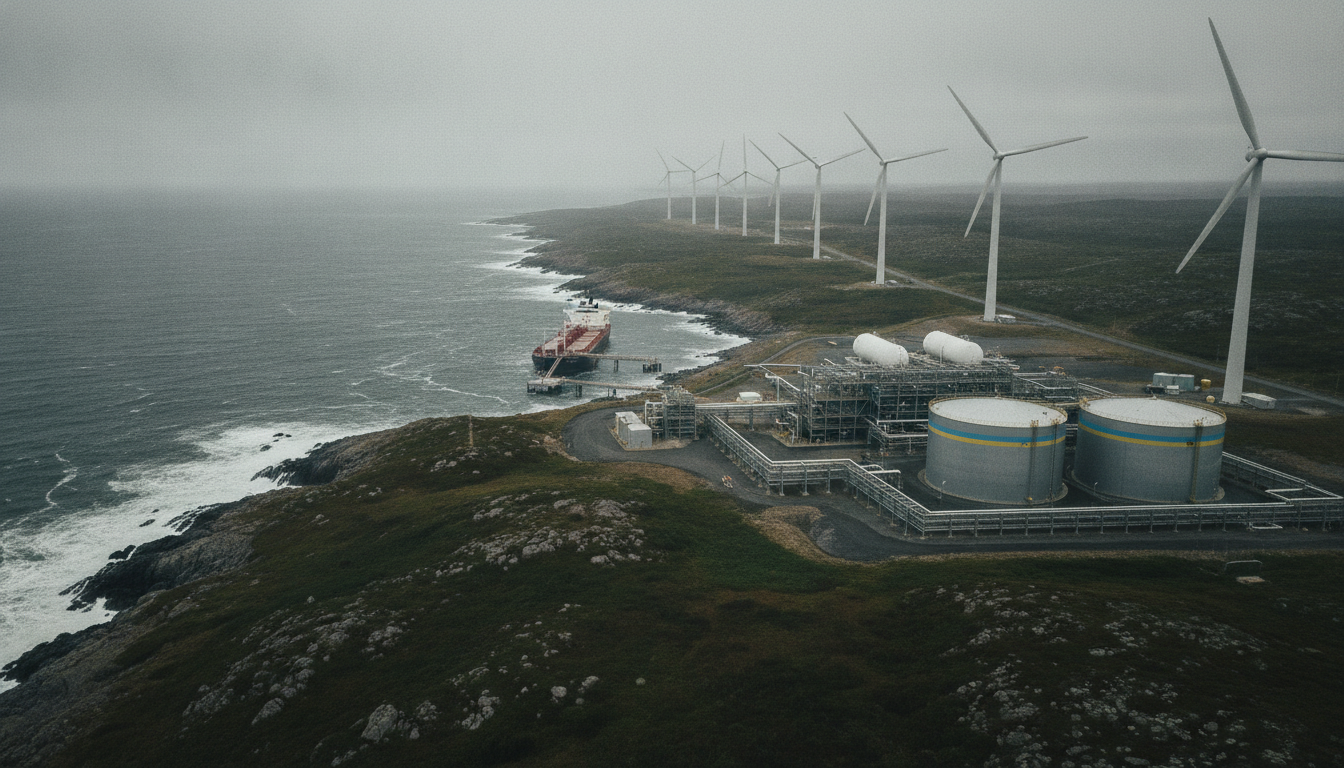
North Atlantic is adding a 481MW wind farm to double its Newfoundland green hydrogen project to about 60,000 tonnes a year for export, even as rival provincial hydrogen schemes stall.
North Atlantic is doubling the size of its green hydrogen project in Newfoundland and Labrador. A planned second phase would add a 481MW wind farm and lift total hydrogen output to about 60,000 tonnes a year for export to global markets.
The St John’s-based company said on 8 July that it had begun the environmental assessment for phase two, on the Avalon Isthmus. It expects to register the phase with the provincial process in the fourth quarter of 2026. The first phase cleared environmental assessment two months earlier.
Phase one centres on a roughly 320MW onshore wind farm near Sunnyside, with about 47 turbines and a 25km transmission line to the Port of Come By Chance. It pairs the wind farm with a green hydrogen plant and a hydrogenation plant at North Atlantic’s existing Come By Chance terminal, and targets about 30,000 tonnes of hydrogen a year.
North Atlantic plans to ship the hydrogen as a liquid organic hydrogen carrier rather than as ammonia. It blends hydrogen with toluene to make methylcyclohexane, a stable liquid that can be handled and moved much like petrol. That lets the project reuse existing terminal tanks and conventional tankers instead of building ammonia-specific infrastructure.
The expansion runs against the wider trend in the province. Several of Newfoundland’s early wind-to-hydrogen schemes have stalled or narrowed as costs, offtake and permitting proved hard to resolve. North Atlantic’s control of its own refinery site and export terminal gives it a route to market that most rivals lack.
The company frames the project around industrial export demand for low-carbon hydrogen and its derivatives. Green hydrogen made from wind can cut emissions in steel, chemicals, refining and heavy transport, though buyers still want firm supply at a competitive price before committing.
Doubling the target raises the project’s power demand and capital needs, and the phase-two timeline now depends on the provincial review. For the moment, North Atlantic is one of the few Atlantic Canadian hydrogen developers still expanding rather than pulling back.
