


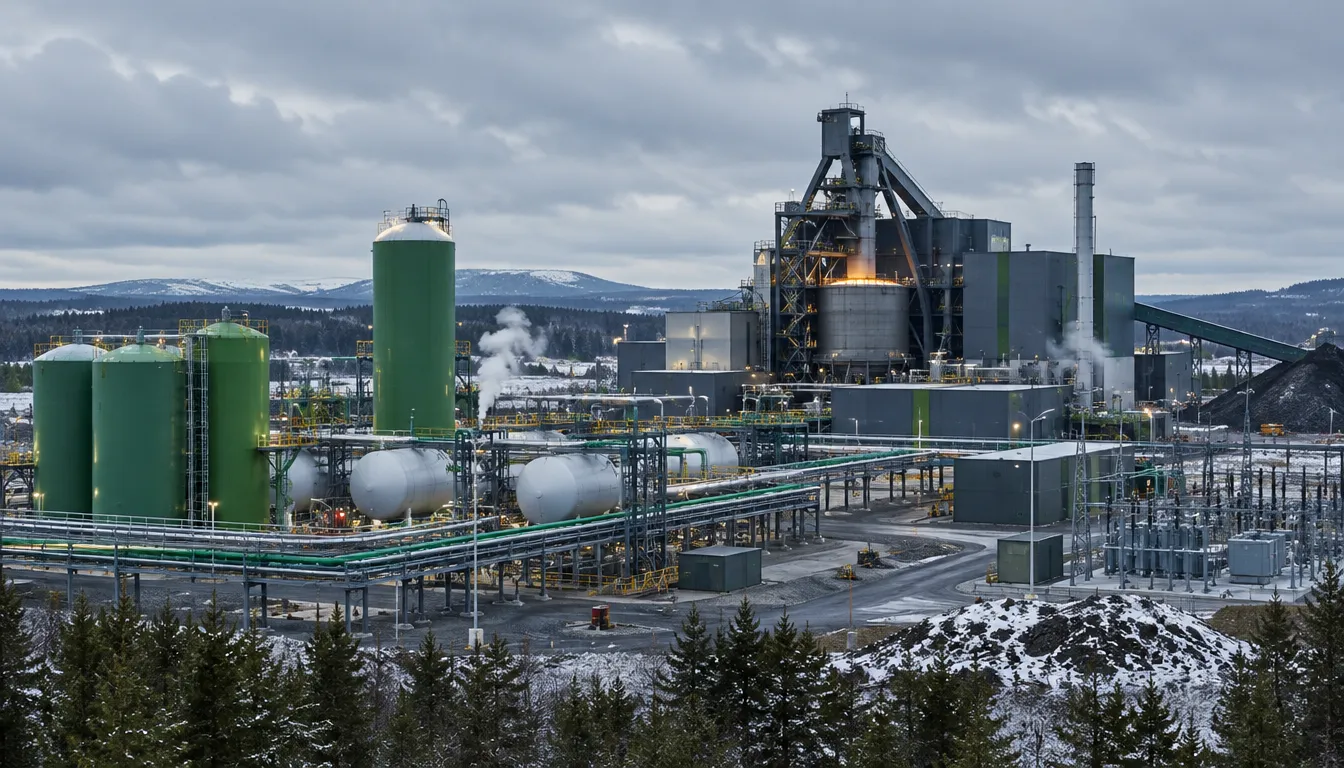
Google will buy green steel certificates from Stegra’s Boden plant in northern Sweden, helping fund near-zero-emission steelmaking as the tech giant works to offset its own rising emissions.
Google will buy green steel certificates linked to Stegra’s plant in Boden, northern Sweden, the two companies said on Thursday, as the search giant works to offset the rising emissions from its data centre build-out.
Under the deal, Google will not take delivery of any physical steel. Instead it will receive green steel certificates covering the emissions reductions tied to up to 91,000 tonnes of Stegra’s output in its first year of production, letting Google count those cuts towards its own climate targets. Stegra will still sell the metal into the open European market as a standard product, without a low-carbon label attached, and will use Google’s payment to help fund the plant’s early years of operation.
The arrangement is the second of its kind for Stegra, formerly known as H2 Green Steel. Microsoft agreed a two-part deal last year to buy both green steel certificates and physical steel for its European data centre suppliers. Neither company has disclosed the financial value of its agreement with Stegra.
Google’s own emissions rose 18% between 2024 and 2025, largely because of the steel, concrete and computing hardware needed for its data centres. Buying green steel certificates lets the company support low-carbon production without reworking its physical supply chains overnight, and it gives Stegra revenue during a difficult ramp-up period after a series of financing setbacks.
Stegra’s Boden plant uses hydrogen made from renewable electricity, rather than coking coal, to convert iron ore into iron before finishing it in electric arc furnaces powered by the same wind and hydropower resources. The company says the process cuts emissions from steelmaking by up to 95% compared with a conventional blast furnace, addressing a sector responsible for roughly 9% of global carbon dioxide emissions each year. Building on the momentum behind Stegra’s €1.4 billion investment earlier this year, the Boden plant is expected to produce 2.5 million tonnes of steel in its first phase, rising to 5 million tonnes at full capacity, though the company has not confirmed a start date.
“By supporting early-stage technologies like Stegra’s green steel, we are helping to create a market for materials that are essential to reducing emissions,” a Google spokesperson said, adding that the deal “contributes to generating increased cash flow to Stegra’s early years of operations and the ramp-up of production.”
Claire Dougherty, an industrial decarbonisation programme manager at RMI, said green steel certificates are “a great mechanism to overcome different market barriers in industries where we need to see increased investment”. A hydrogen-based steel plant, she said, “can cost billions of dollars, and that can be very difficult to get funding for, particularly without a guarantee that someone’s going to buy your decarbonized product at a premium.” Data centre operators are often willing to pay that premium but rarely buy steel directly, so certificates let them fund production at a distance.
Stegra, alongside the cleantech firms Electra and Charm Industrial, is working with the Roundtable on Sustainable Biomaterials to build a formal book-and-claim market for iron and steel certificates, with shared standards for how emissions reductions are counted, verified and traded. RMI is due to publish a framework for running such a system next week. Electra, which produces iron using room-temperature electrochemical cells rather than a blast furnace, struck a similar certificate deal with Meta last year and is preparing to start a demonstration plant in Jefferson County, Colorado, before targeting a first commercial site in the early 2030s.
“Our agreement with Meta was an early example to indicate that there’s a market interest in these types of technologies,” said Maressa Brennan, Electra’s senior director of regulatory policy and markets. “The work we’re doing now is to more formally establish a marketplace that helps these approaches scale.”
For industrial buyers watching the Google deal, the signal is less about the search giant’s own steel needs than about whether a growing certificate market can pull enough capital into hydrogen-based steelmaking to get plants like Stegra’s fully running.
