


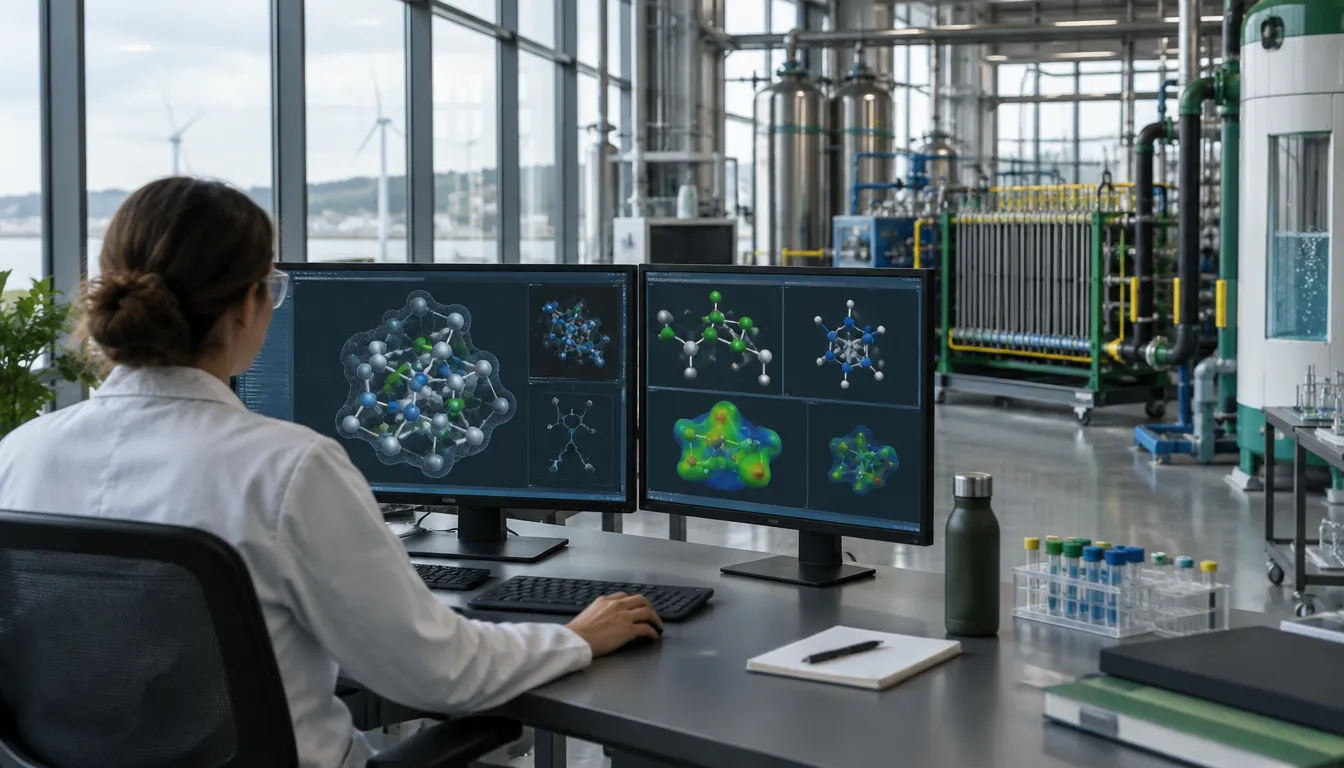
ENEOS Holdings used AI catalyst discovery from Matlantis and NVIDIA to screen 100 million candidate materials for hydrogen electrolysis, cutting a years-long search to just months.
ENEOS Holdings has used AI catalyst discovery to screen around 100 million candidate materials for hydrogen electrolysis, cutting a search that once took years down to a few months, Matlantis and NVIDIA said on 17 September.
The Japanese energy group combined Matlantis PFP, a general-purpose machine learning interatomic potential, with NVIDIA ALCHEMI, an accelerated computing platform for chemistry and materials workloads. Together the two systems let ENEOS evaluate huge numbers of candidate structures for oxygen evolution reaction catalysts, the materials that determine how efficiently water splits into hydrogen and oxygen during electrolysis.
AI catalyst discovery of this kind matters for hydrogen because catalyst performance is one of the main costs standing between pilot-scale electrolysers and commercial deployment. Materials teams have traditionally relied on computational modelling alongside laboratory synthesis and trial and error, a slow combination once the number of candidate compounds grows into the millions. Screening at the scale ENEOS reached would not have been realistic with those older methods within a normal project timeline.
PFP is designed to keep near quantum-level accuracy while running far faster than conventional simulation methods, and it supports all 96 chemical elements in a single model. That breadth let ENEOS apply one system across a wide range of candidate chemistries rather than building separate models for each material family. NVIDIA ALCHEMI then scaled the resulting simulations across GPU infrastructure, making it possible to evaluate spaces that would be impractical to test with conventional computing, and turning AI catalyst discovery into a routine early step rather than a specialist research exercise.
“The development of innovative materials is becoming increasingly important to achieving a carbon-neutral society,” said Takeshi Ibuka, general manager of the AI innovation department at ENEOS Holdings Corporation. He said the approach let researchers “explore possibilities that would have been difficult to reach through conventional approaches”, and that ENEOS intends to keep applying computational tools to materials challenges facing the energy transition.
Daisuke Okanohara, president and chief executive of Matlantis, said the collaboration showed “what is possible when industry leaders bring together deep materials expertise, advanced computing and AI”, and that the companies plan to keep working with ENEOS on the search for materials the energy transition depends on. Dion Harris, senior director for HPC, cloud and AI infrastructure at NVIDIA, said the work demonstrated how high-throughput simulation “can accelerate the search for OER catalysts” central to green hydrogen production.
Matlantis was established in 2021 as a joint venture between Preferred Networks and ENEOS Corporation, which changed its name in July 2025. The company says its Matlantis platform, delivered as a cloud service, is now used by more than 150 companies, universities and research institutions in Japan, with international customers including Volkswagen and Hyundai. It is applied across catalysts, batteries, semiconductors, alloys, lubricants, ceramics and chemicals, giving AI catalyst discovery a role well beyond hydrogen alone.
The approach follows a pattern already visible elsewhere in AI-driven materials discovery, where machine learning potentials are used to narrow enormous candidate spaces before committing to physical synthesis. Chemicals and materials groups across Japan and beyond are under pressure to cut the years-long lead times that have historically slowed new catalyst rollouts, and ENEOS is one of the country’s largest refiners as it builds out a wider hydrogen and low-carbon fuels business.
For electrolyser makers and hydrogen project developers, the ENEOS work suggests that catalyst breakthroughs increasingly depend on computing partnerships as much as chemistry expertise. AI catalyst discovery does not replace laboratory validation, since ENEOS still needs to synthesise and test the priority candidates the screening identified, but it narrows that list dramatically before any physical work begins, and the ability to screen at scale now sets the pace for how quickly new materials reach the production line, giving well-resourced groups like ENEOS an edge over rivals still relying on slower, conventional discovery pipelines.
