


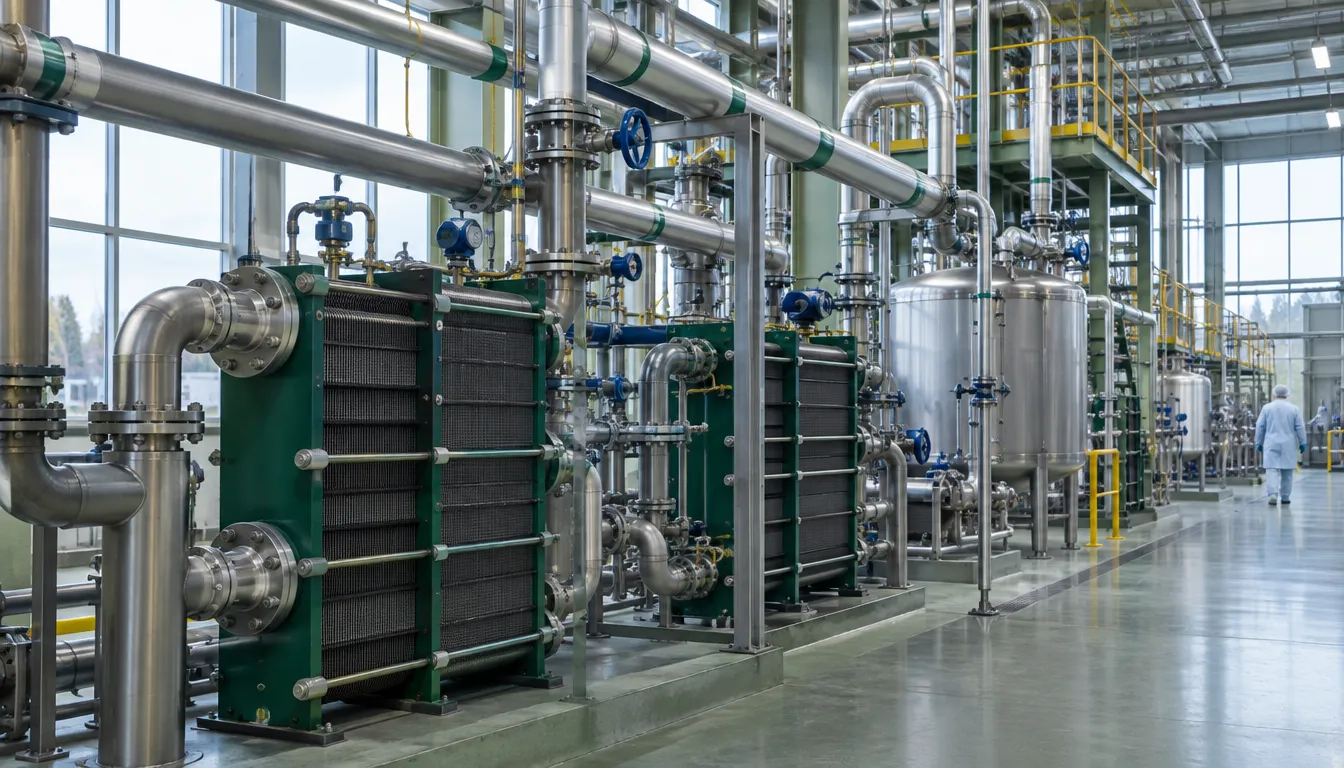
Sanofi, UCB and Opella Healthcare have joined AstraZeneca as founding members of the Clean Heat Program, targeting industrial heat as the largest remaining source of pharmaceutical manufacturing emissions.
Multinational pharmaceutical companies Sanofi, UCB and Opella Healthcare Group have joined AstraZeneca as founding members of the Clean Heat Program, an initiative created by supply chain intelligence network Secaro and sustainability consultancy ERM to replace fossil-fuel heating across pharmaceutical manufacturing sites. AstraZeneca first joined the programme in December 2025, and its expansion to three further multinationals broadens the coalition working on a part of pharmaceutical manufacturing that has proved hard to decarbonise.
The healthcare sector accounts for around 5% of global greenhouse gas emissions, and industrial heat is often the largest remaining source of a manufacturer’s operational footprint once electricity supply has been switched to renewables. Sanofi has committed to cutting scope 1, 2 and 3 emissions by 90% between 2019 and 2045, UCB has set the same 90% target over the same period, and Opella has pledged a 58.8% cut by 2034 and 90% by 2050 from a 2023 baseline. All three targets are validated by the Science Based Targets initiative, meaning the companies cannot rely on offsets alone to meet them.
Pharmaceutical manufacturing uses process heat for sterilisation, solvent recovery, drying and other steps that have traditionally run on natural gas or steam boilers. The Clean Heat Program is designed to give members technical expertise, risk reduction and access to proven low-carbon heating technologies. It addresses barriers the companies say have slowed action on industrial heat, including limited in-house expertise, thin supply-chain engagement, funding constraints and the complexity of upgrading existing heat systems without disrupting regulated manufacturing processes.
Sanofi’s Giannis Kourousias said heat “has been one of the most challenging areas across the pharmaceutical value chain on the road to net zero.” Opella’s Marissa Saretsky said decarbonising industrial heat is “an important challenge to tackle” as part of the company’s net-zero ambition, language that reflects how central heat has become to pharmaceutical companies’ remaining emissions.
Secaro has also expanded its partner network to include Schneider Electric and 3Degrees, adding energy audits, investment-grade studies and renewable natural gas and biomethane procurement to the services available to members. Schneider Electric’s SE Advisory Services arm carries out the energy studies and investment-grade audits that help manufacturers identify which sites can switch to electrified or fuel-switched heat first, while 3Degrees focuses on sourcing renewable natural gas and biomethane across United States and European markets for sites where full electrification is not yet practical.
Dave Rimkus of Schneider Electric’s SE Advisory Services said accelerating supply-chain decarbonisation depends on streamlining the path to lower-carbon alternatives, while Secaro’s Emily Prior said cutting emissions across manufacturing, energy use and supply chains also builds a more sustainable and resilient healthcare system. Both framings point to the same practical problem: industrial heat upgrades typically require site-by-site engineering work that most manufacturers cannot resource alone.
The programme builds on the earlier AstraZeneca partnership with ERM and Secaro that first tackled industrial heat in the pharmaceutical supply chain. Jon Hughes of ERM said decarbonising industrial heat remains one of the largest and most technically complex opportunities for manufacturers, a signal that other pharmaceutical companies are likely to face the same pressure to act on their own industrial heat systems as scope 1 and 2 targets come due.
Pharmaceutical manufacturing sits alongside other process industries, including food and beverage, chemicals and paper, where heat has proved harder to electrify than power supply because it often needs high, steady temperatures that batteries and standard heat pumps cannot yet deliver economically at scale. Programmes such as Clean Heat are built around matching each site to whichever low-carbon option fits its temperature and reliability needs, whether that is electrification, biomethane, waste-heat recovery or another route, rather than applying a single technology across an entire manufacturing network.
For Sanofi, UCB and Opella, joining a shared programme rather than commissioning individual studies gives each company access to engineering expertise and supplier relationships that Secaro and ERM have already built through the AstraZeneca partnership, shortening the time needed to move from an emissions target to a funded heat project at a specific site.
