


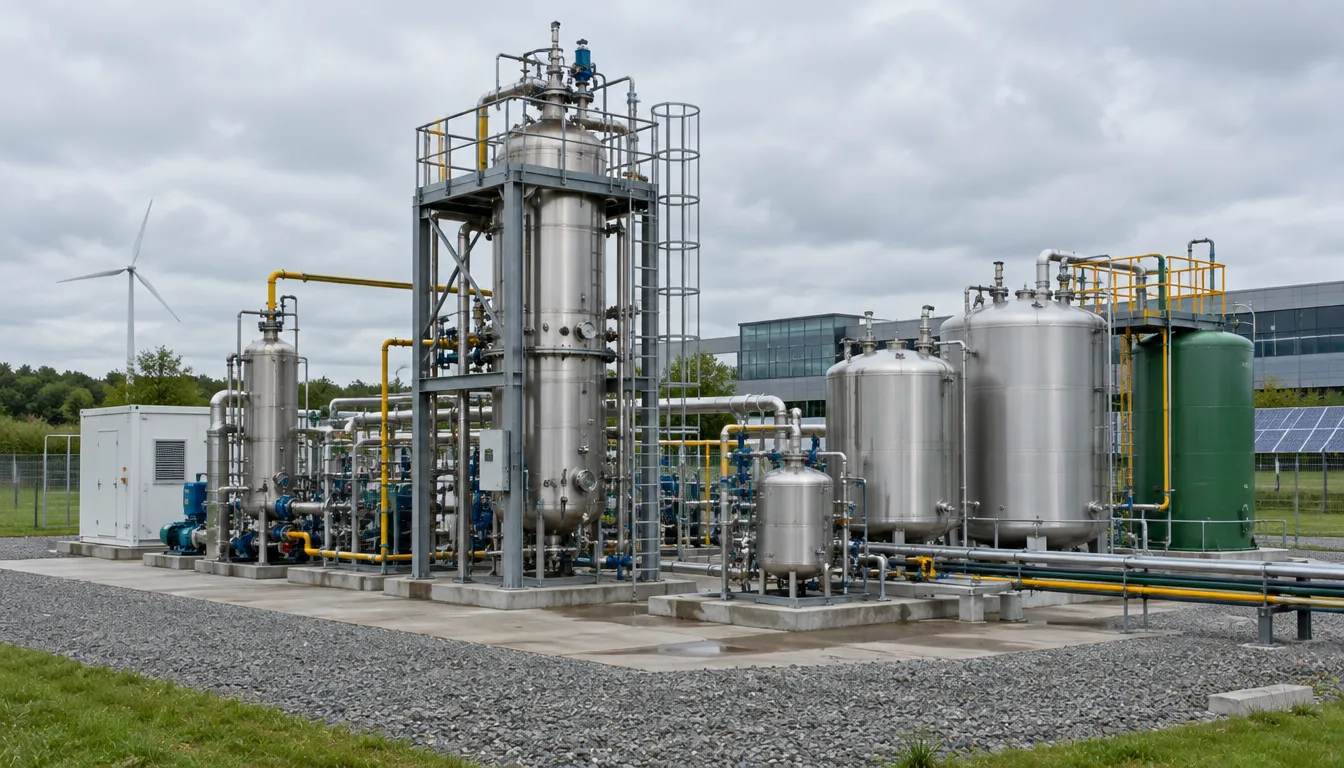
CAC Engineering’s pilot plant in Freiberg, Germany has produced 300,000 litres of synthetic gasoline, showing its power-to-liquids process can run reliably over a sustained period.
A pilot plant in Freiberg, Germany has produced 300,000 litres of synthetic gasoline, a threshold its developer says demonstrates that its power-to-liquids process can run reliably over a sustained period rather than only in short bursts.
The facility, run by CAC Engineering at TU Bergakademie Freiberg, uses the company’s METHAFUEL technology to convert e-methanol into synthetic gasoline through the DeCarTrans research programme. Reaching 300,000 litres of cumulative output matters because continuous, reliable operation, rather than peak output in a single run, is what investors and engineering firms look for before committing to a commercial-scale plant.
Saxony’s Minister-President Michael Kretschmer visited the site on 11 September to see the technology, meeting representatives from TUBAF and CAC Engineering to discuss its progress towards industrial deployment. The visit reflects the political attention synthetic gasoline projects are drawing in Germany, where the government has backed several e-fuel pilots as part of its wider industrial decarbonisation push.
“With 300,000 litres produced, we have demonstrated that our technology operates reliably in continuous operation,” said Jörg Engelmann, CAC Engineering’s managing partner. He said the pilot still needs “reliable framework conditions so that concrete project concepts can be turned into investment decisions”, pointing to the gap between a working pilot and the policy certainty needed to finance a full-scale plant.
The pilot draws its e-methanol feedstock from a Danish power-to-X facility run by European Energy and Mitsui, which has supplied the site since November 2025. Earlier testing saw the plant run continuously for nine weeks, and CAC expects cumulative synthetic gasoline output to reach 380,000 litres by mid-2027, supporting fuel analysis and vehicle testing programmes. Sourcing e-methanol from an established supplier rather than producing it on site lets CAC focus its own development effort on the conversion step, though it also means the pilot’s output depends on a separate company’s renewable electricity and hydrogen supply chain running smoothly.
The most concrete signal of commercial intent so far comes from German eFuel One, which plans to build the country’s first commercial eFuel facility in Steyerberg with a target capacity of 75 million litres of synthetic gasoline a year. That plant is expected to start up in 2029, and BMW Group has said it intends to use eFuels from the project for initial vehicle fills from the same year, giving the technology a named automotive customer well before commercial output begins. A named customer at this stage carries weight in a sector where many e-fuel proposals have struggled to move past announcements, since it signals at least one large buyer is prepared to plan around the plant’s output rather than waiting to see if it materialises.
CAC is also developing a related process, METHAJET, to produce synthetic aviation kerosene through the same Fischer-Tropsch-adjacent route, and says it has already produced samples meeting Sustainable Aviation Fuel specifications. That parallel work suggests the company sees synthetic gasoline and synthetic jet fuel as variations on a shared platform rather than separate technology bets, a strategy similar to the one other carbon-to-fuel developers are pursuing as they look to spread development costs across more than one end market. Both fuels compete for the same limited pool of renewable hydrogen and captured carbon dioxide, so a synthetic gasoline plant and a synthetic kerosene plant built on shared process technology could in principle be reconfigured towards whichever product commands the stronger price signal at the time.
For fuel producers and automakers watching the space, the Freiberg result is a step towards proving synthetic gasoline can be made at meaningful volumes without interruption, but it stops short of proving the economics work at commercial scale. That test will fall to eFuel One’s Steyerberg plant, whose 2029 start date gives the wider industry a concrete deadline for whether synthetic gasoline can move from pilot output to a real production line.
